

Fire extinguishers do not have one universal expiration date, but they do have enforceable service-life limits based on extinguisher type, maintenance status, and cylinder testing requirements. A rechargeable extinguisher remains serviceable only while it passes required inspection, annual maintenance, recharge, and hydrostatic testing. A non-rechargeable extinguisher is different: it is removed from service at 12 years from the date of manufacture.
Under OSHA 29 CFR 1910.157, portable fire extinguishers require monthly visual inspection, annual maintenance, and hydrostatic testing at the applicable interval, commonly 5 or 12 years depending on extinguisher type. Stored-pressure dry chemical extinguishers that require a 12-year hydrostatic test also require internal maintenance every 6 years. OSHA also states that hydrostatic testing intervals vary by extinguisher type under Table L-1.
The technical service life differs by extinguisher construction and agent. Rechargeable dry chemical units are governed by 6-year internal maintenance and 12-year hydrostatic testing; CO₂, water, wet chemical, and clean agent units follow their own hydrostatic test intervals and cylinder condition limits. A green pressure gauge does not override corrosion, leakage, missing service records, damaged hoses, an unreadable label, an expired hydrostatic test, or the 12-year removal rule for disposable units.
How Long Do Fire Extinguishers Last?
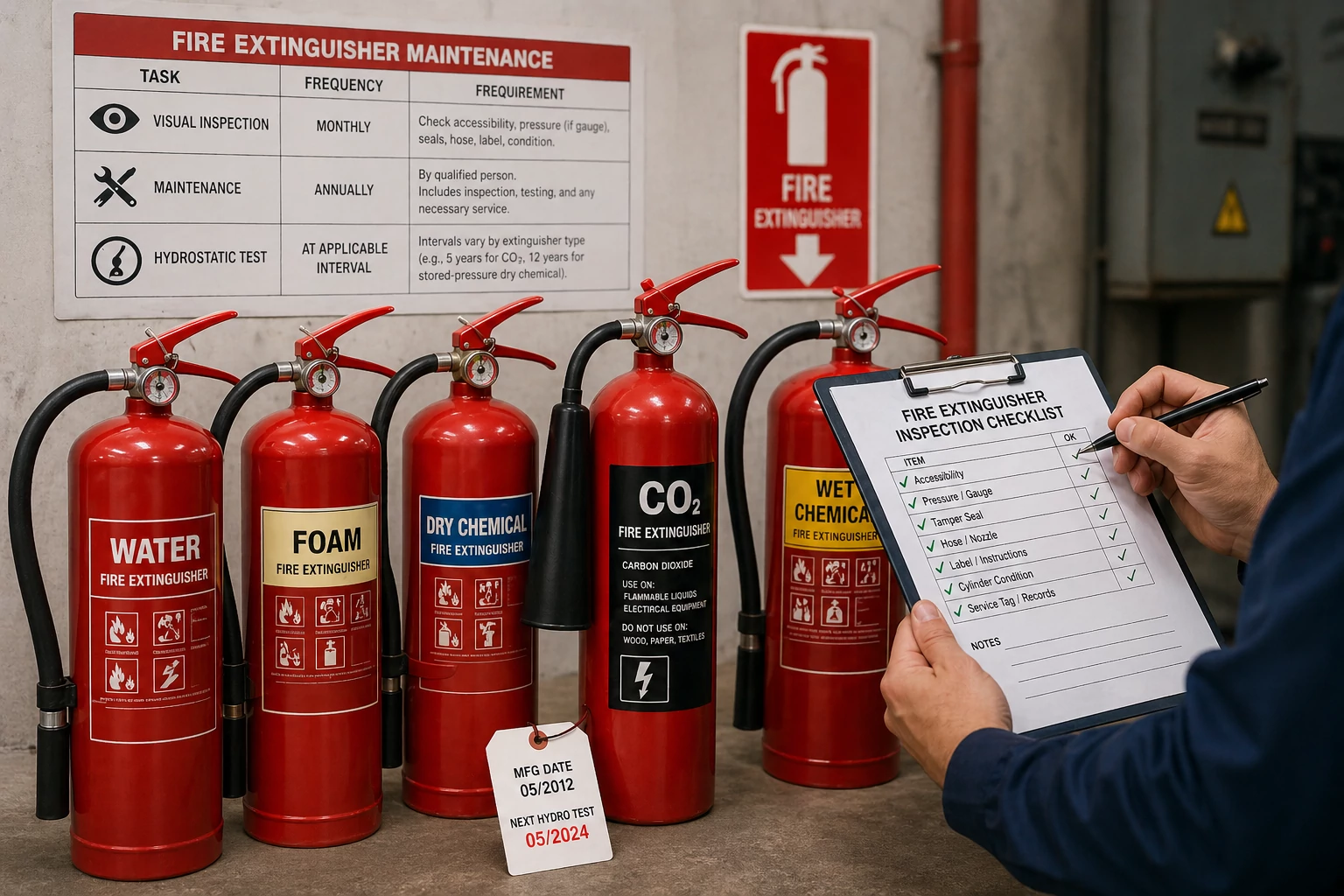
Fire extinguishers do not have one universal service life; their usable life is controlled by extinguisher type, required service intervals, and cylinder condition. Under OSHA 29 CFR 1910.157, portable fire extinguishers provided for employee use in workplaces require monthly visual inspection, annual maintenance, and hydrostatic testing at the applicable interval. OSHA Table L-1 assigns different test intervals by type, including 5 years for carbon dioxide extinguishers and 12 years for stored-pressure dry chemical extinguishers with mild steel, brazed brass, or aluminum shells.
Mandatory retirement applies most clearly to non-rechargeable units. Under NFPA 10 practice, non-rechargeable dry chemical and non-rechargeable clean or halogenated agent extinguishers are removed from service 12 years from the date of manufacture. Rechargeable extinguishers do not have one universal calendar retirement date, but continued service depends on annual maintenance, recharge when needed, required internal examination, hydrostatic testing, and cylinder condition. Stored-pressure dry chemical extinguishers that require a 12-year hydrostatic test also require internal maintenance every 6 years.
Technical service life is limited by both the extinguishing agent and the pressure-retaining parts. Dry chemical agent can compact, cake, or discharge poorly when moisture intrusion, vibration, seal failure, or long-term lack of maintenance affects the powder bed. Water, foam, and wet chemical extinguishers are more exposed to contamination, corrosion, freezing risk, blocked discharge components, and seal failure. Clean agent units are serviceable only while charge weight, pressure, valve integrity, and cylinder condition remain within service limits. CO₂ extinguishers are verified primarily by weight, not by a pressure gauge, and normally follow a 5-year hydrostatic test interval. A unit that appears charged is not automatically serviceable if the agent, valve, hose, label, service records, or cylinder no longer meets code and manufacturer requirements.
Service Limits by Extinguisher Type
| Extinguisher Type | Visual Check | Maintenance | Internal Service | Hydro Test | Removal Rule |
| Non-rechargeable dry chemical | Monthly | Annual | – | – | 12 yr from manufacture |
| Rechargeable dry chemical, stored-pressure | Monthly | Annual | 6 yr | 12 yr | If failed / damaged |
| Dry chemical, stainless steel shell | Monthly | Annual | Per service tag | 5 yr | If failed / damaged |
| CO₂ | Monthly | Annual | Per service tag | 5 yr | If failed / underweight |
| Water / water mist | Monthly | Annual | Per service tag | 5 yr | If failed / corroded |
| Wet chemical | Monthly | Annual | 5 yr typical | 5 yr | If failed / contaminated |
| Foam / AFFF | Monthly | Annual | Per maker | 5 yr | If failed / degraded |
| Clean agent / Halon-type | Monthly | Annual | Per maker | 12 yr | 12 yr if non-rechargeable |
Agent Aging Risks
| Agent Type | Fixed Agent Expiry | Main Failure Risk | Key Service Check |
| Dry chemical | No | Caking / moisture / poor flow | Pressure + powder condition |
| CO₂ | No | Leakage / low charge | Weight + valve |
| Water / water mist | No | Corrosion / freezing | Cylinder + agent condition |
| Wet chemical | No universal | Contamination / nozzle blockage | Agent + discharge parts |
| Foam / AFFF | Maker-dependent | Separation / degradation | Agent quality + maker limit |
| Clean agent | No | Leakage / undercharge | Weight or pressure |
| Disposable unit | Yes | No recharge / no internal service | 12 yr removal |
Factors That Affect Fire Extinguisher Service Life
Fire extinguisher service life is affected by environment, mechanical exposure, tampering, and service history.
A unit can become unfit for service before its scheduled test date if its cylinder, agent, pressure system, valve, hose, label, or maintenance record no longer meets code and manufacturer requirements. These factors do not just shorten usable service life; they directly affect discharge reliability and pressure-retention safety.
Key life-reducing factors include:
- Weather and corrosive exposure: Rain, ice, salt air, dirt, chemicals, and unprotected outdoor storage accelerate corrosion, label loss, hose cracking, and valve deterioration. Use an approved or weather-resistant fire extinguisher cabinet, cover, or protected mounting location where outdoor or corrosive exposure exists.
- Long-term vibration: Vehicle, marine, or industrial mounting can compact dry chemical powder, loosen brackets or hardware, and reduce discharge reliability. Use a vehicle/marine bracket approved for the extinguisher model, secure the unit against movement, and increase inspection frequency where vibration is expected.
- Temperature exposure: Storage outside the extinguisher’s listed operating range can affect pressure stability, seals, cylinder stress, and water-based agents. Select a unit rated for the actual temperature range, such as -40°F to +120°F or -65°F to +120°F on certain models, and use the nameplate or manufacturer manual as the controlling limit.
- Humidity exposure: External moisture drives corrosion; internal moisture becomes critical when seals, valves, or cylinder integrity are compromised. Install the unit away from standing water, washdown zones, and constant condensation, and inspect for rust, pitting, leakage, damaged labels, or seal failure.
- Tampering or vandalism: Missing pins, broken tamper seals, partial discharge, blocked hoses, damaged handles, or moved units make service status unreliable. Use cabinets, tamper-resistant covers, intact seals, inspection tags, and routine visual checks without blocking visibility or access.
- Service history: Missing tags, overdue annual maintenance, expired hydrostatic tests, improper recharge, wrong agent fill, or undocumented repairs make the extinguisher unverifiable. Maintain service records, verify manufacture and test dates, and use qualified fire extinguisher service technicians for recharge, internal maintenance, and testing.
When Should a Fire Extinguisher Be Removed from Service?
A fire extinguisher should be removed from service when its condition, records, or required test status can no longer support safe use.
Calendar age alone does not keep an extinguisher valid, and a green pressure gauge confirms pressure indication only. It does not verify agent condition, hydrostatic test status, service history, hose condition, label legibility, or cylinder integrity.
Common removal triggers include:
- 12-year disposable limit: non-rechargeable dry chemical extinguishers are removed from service 12 years from the date of manufacture.
- Expired hydrostatic test: the unit is past its required 5-year or 12-year hydrostatic test interval, depending on extinguisher type.
- Disqualifying cylinder damage: welded or brazed repairs, damaged threads, pitting corrosion, fire exposure, distortion, or severe mechanical injury remove the unit from normal service evaluation.
- Discharge or pressure loss: partial discharge, leakage, low pressure, or missing charge makes the unit unfit until serviced or replaced.
- Damaged components: broken handles, blocked hoses, damaged nozzles, missing pull pins, or broken tamper seals invalidate readiness.
- Missing identification: unreadable labels, missing manufacture date, missing service tag, or incomplete test record prevents service verification.
- Wrong or unknown recharge: incorrect agent fill, improper recharge, or undocumented repair makes the extinguisher unreliable.
Fire extinguishers do not have one universal expiration date; their service life depends on extinguisher type, required maintenance, hydrostatic testing, cylinder condition, and whether the unit is rechargeable or non-rechargeable.
A green pressure gauge does not prove compliance, because agent condition, service history, hose/nozzle integrity, labels, and test dates can still make the extinguisher unfit for use.
The correct standard is not age alone, but whether the extinguisher remains documented, accessible, maintained, pressure-safe, and within OSHA, NFPA 10, and manufacturer service limits.