
Home » Mini Fire Truck
Mini Fire Truck
Poseidon supplies electric mini fire trucks for site response, supplementary water delivery, and configured facility duties. The range includes a compact fire tricycle, the 250gal Mini Fire Truck, and the 800gal Mini Fire Truck, with different vehicle dimensions, water tanks, and equipment arrangements.
Select the vehicle by the role assigned in the site response plan, access width and turning space, required water supply, pump duty, loaded operating mass, and charging arrangement. Available OEM requirements can include tank configuration, pump and nozzle arrangement, battery specification, equipment storage, and vehicle appearance.
For a configuration review or bulk quotation, send the operating environment, vehicle-size constraints, water and pump requirements, daily duty cycle, order quantity, and destination market.
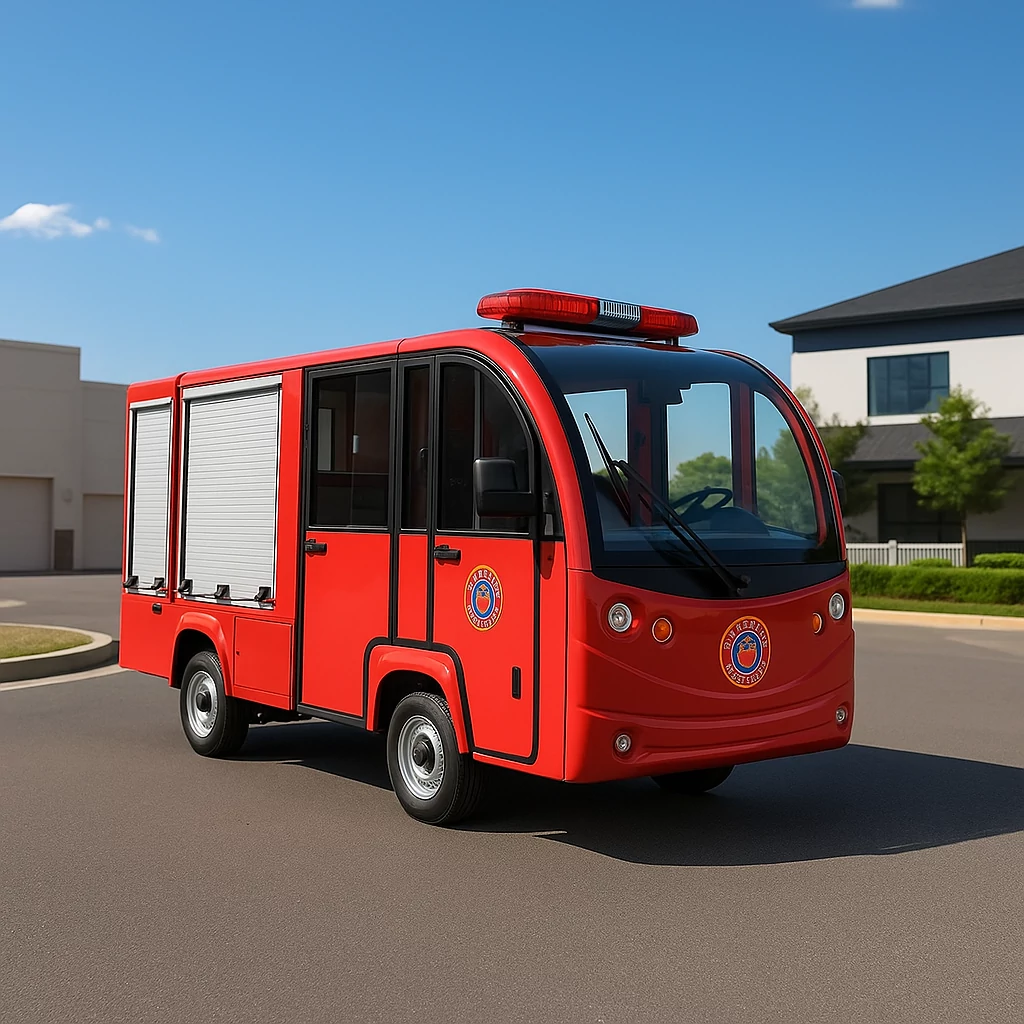

Fire Tricycle
- 300 L tank (approximately 79 US gal)
- 137.8 × 43.3 × 52 in
- Motor options: 500–1000 W
- 48 V battery configuration

250gal Mini Fire Truck
- 1,000 L tank (approximately 264 US gal)
- 159.4 × 58.3 × 82.7 in
- 72 V electric drivetrain
- Battery and motor configuration by order

800gal Mini Fire Truck
- 800 Gal
- 191.3×61.0×90.9″
- 72V/7.5KW AC Motor
- 3EVF-200AH, 12 units
Select a Mini Fire Truck for the Site

Match the Vehicle to the Site
Start with gates, internal roads, aisle width, overhead clearance, turning space, gradients, and surface conditions. Compare the dimensions of the fire tricycle, 250gal, and 800gal configurations against the actual route. Check access with the vehicle loaded and with the selected equipment installed.
Define Water Capacity and Pump Duty
Assign the vehicle a clear role in the response plan: localized first response, supplementary water delivery, or a configured maintenance task. Select the onboard water volume and replenishment arrangement for that role. Request the pump flow at the required working pressure, together with the hose, nozzle, and discharge arrangement. Maximum flow and maximum pressure figures alone may refer to different operating points.
Review Operating Mass and Road Use
Assess the full water load, crew, tools, hose, and other equipment against the chassis, axle, tire, and braking ratings for the final vehicle. For public-road operation, include the destination market and required vehicle approvals in the specification. For facility use, describe the route, terrain, staffing, and operating procedures.
Plan Battery Duty and Charging
Provide expected travel distance, load, gradients, frequency of use, pump duty, and the time available between deployments. Specify the available charging supply and required charger connection. The selected battery and charger should be reviewed as part of the complete vehicle configuration; an unloaded range figure does not define the working duty cycle.
Configure Equipment for the Order
Poseidon can review tank construction, pump and nozzle arrangement, hose storage, onboard tools, battery specification, body layout, and branding requirements for OEM or bulk orders. Required test reports, inspection records, standards, and vehicle documentation depend on the selected configuration and destination market.
Compare other fire vehicles when the required water supply, operating mass, or equipment role calls for a different platform.
Agility
Compare vehicle width, height, turning space, ground clearance, gradients, and access surfaces with the planned site route. Review these conditions with the selected equipment and full operating load.
Customization
OEM review can cover tank construction, pump and nozzle arrangement, battery specification, equipment storage, body layout, and branding. Define the required changes and documentation before quotation.
Sustainability
Specify the charging power supply, charger connection, storage location, and daily duty cycle. Energy use and service needs depend on the final battery, drivetrain, load, and operating pattern.
Efficiency
Match the water tank, pump operating point, hose and nozzle arrangement, and replenishment plan to the required vehicle role. Include these requirements in the configuration request rather than specifying tank volume alone.
Request a Mini Fire Truck Configuration or OEM Quote
For a mini fire truck configuration review or OEM quotation, provide:
- Intended vehicle role and operating environment
- Preferred model, required water volume, and quantity
- Access width, height, turning space, terrain, and operating-load requirements
- Required pump flow at working pressure, hose/nozzle arrangement, and water replenishment method
- Travel and work duty cycle, charging power supply, and charger requirements
- Crew and equipment layout, tank material, branding, labeling, and packaging requirements
- Destination market, public-road or facility-only use, and required standards, approvals, or inspection documentation
Poseidon can match these inputs to the available compact vehicle configurations and review customization, documentation, lead time, and quotation for the order.