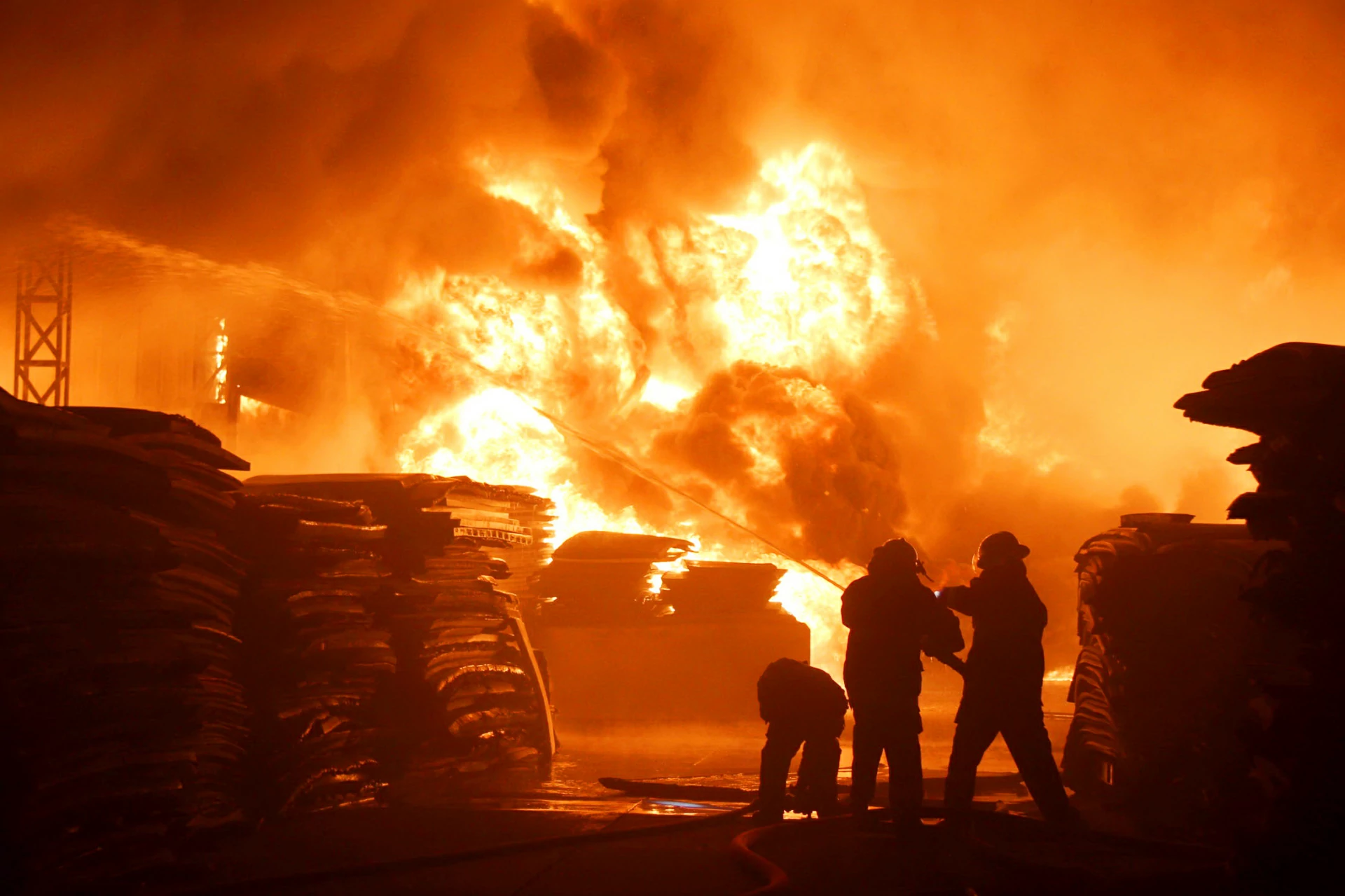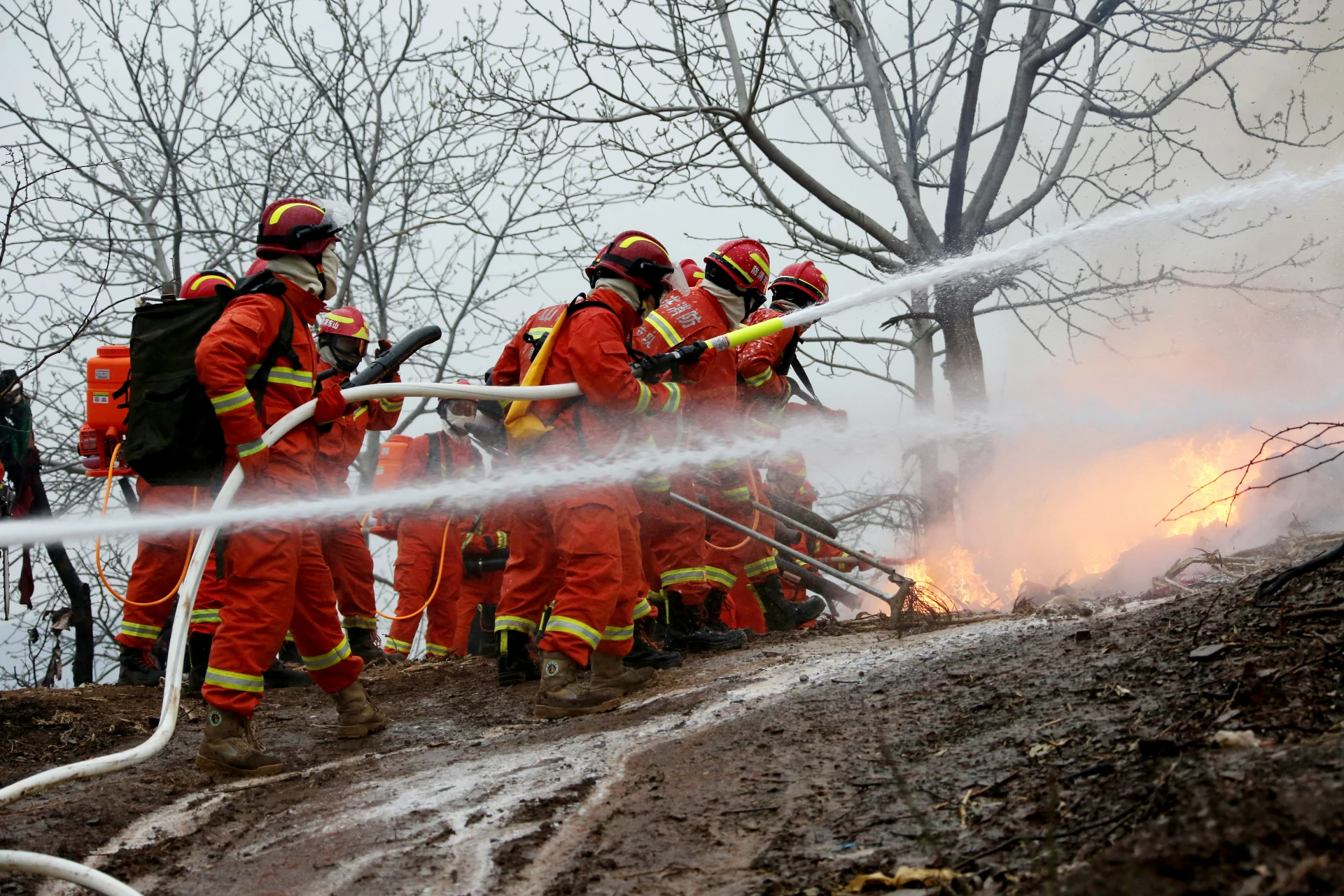
Firefighters rely on four core components in firefighting operations: extinguishing agents (water, foam, aerosols, cleaning gases, fine water mist, etc.), firefighting equipment (various storage, delivery, and release devices), tactics (direct attack, control, containment, etc.), and firefighting vehicles (individual soldiers, teams, vehicles, drones, etc.).
Ultimately, firefighting operations always target the fire triangle: reducing heat, separating fuel, and removing oxygen.
What Kind Of Extinguishing Agent Do Firefighters Use To Put Out Fires?
Depending on the type of fire, commonly used fire extinguishing agents are mainly divided into the following categories, each with different applicable scenarios and characteristics:
- Water/Water-based fire extinguishing agents: The most common physical fire extinguishing agent, extinguishing fire through cooling. Primarily suitable for Class A solid fires (such as wood, paper, etc.). However, it cannot be used to extinguish fires involving energized equipment, oils, or water-sensitive substances (such as potassium, sodium, etc.).
- Foam fire extinguishing agents: Extinguish fires by covering the fire with foam to isolate it from the air. Suitable for Class A solid and Class B liquid fires (such as gasoline, kerosene, etc.). Based on composition, they can be divided into protein foam, fluoroprotein foam, aqueous film-forming foam, etc. Alcohol-resistant foam can be used to extinguish fires involving water-soluble liquids such as alcohol.
- Dry powder fire extinguishing agents: Divided into Class BC (suitable for Class B and C fires) and Class ABC (suitable for Class A, B, C, and E fires). They have a wide range of applications, but leave residue after extinguishing and are not suitable for use on precision instruments.
- Carbon dioxide (CO₂) extinguishing agent: Extinguishes fires by isolating oxygen. Suitable for Class B and C fires, as well as Class E fires involving energized equipment. Leaves no residue after extinguishing, making it suitable for precision instruments and important documents.
- Clean gas extinguishing agents: Such as hexafluoropropane, suitable for Class A, B, C, and E fires. High extinguishing efficiency and no pollution, commonly used to protect precision equipment and computer rooms.
- Metal extinguishing agents (Class D): Specifically used for extinguishing Class D metal fires (such as potassium, sodium, magnesium, etc.). The appropriate extinguishing agent must be selected according to the type of metal.
- PS: Halogenated alkane extinguishing agents are being phased out due to ozone depletion and are currently only for historical reference. When selecting an extinguishing agent, it is necessary to match it according to the fire type (Class A/B/C/D/E) to avoid incorrect use.
What Fire Suppression Equipment Do Firefighters Use?
Storage Devices
Fire extinguishing agent storage devices must ensure that the extinguishing agent does not become ineffective, does not decrease in quantity, and is readily available before firefighters arrive and during operations. In past firefighting operations, problems caused by storage devices mainly included: having extinguishing agent but being unable to replenish it; delivering extinguishing agent but having insufficient terminal pressure; and spraying extinguishing agent but failing to extinguish the fire.
Typical storage devices include:
- Fire extinguisher cylinders
- Fire truck water tanks
- Foam concentrate tanks
- Dry powder tanks
- Gas extinguishing cylinder assemblies
- Fine water mist storage tanks
- Backpack-mounted fire extinguishing device agent tanks
- Airborne fire extinguishing module storage compartments
Delivery Devices
Delivery equipment includes:
- Fire pump
- Pipelines
- Valve assemblies
- Water hoses
- Suction pipes
- Riser system
- Proportional mixer
- Diverter
- Pressure reducing valves
- Check valves
- On-board liquid/gas supply system
- Dry powder or gas delivery pipelines
For delivery systems, the most important factors are end-point flow rate, end-point pressure stability, and friction loss control. No matter how impressive the pump outlet data is, if pressure drops after passing through risers, elevation differences, hoses, and valves, it becomes meaningless for on-site firefighting operations. USFA tests and discussions on standpipes indicate that historically, increasing the distal outlet pressure from 65 psi to 100 psi was essentially to ensure a usable jet and flame containment capability at the nozzle end. In high-rise operations, pump pressure is often adjusted using empirical values like “125 psi + 5 psi per floor,” reflecting issues of vertical and frictional losses.
Discharge / Application Devices
Typical equipment includes:
- Streaming water guns
- Multi-functional/combination water guns
- Spray water guns
- Foam guns, foam cannons, foam generators
- Dry powder guns
- Gas nozzles
- Fine water mist nozzles
- Fire monitors, remote-controlled monitors
- Airborne spray heads, throw-and-release devices
- Fire blankets, fire blankets, and other non-media delivery suppression tools.
The most important performance indicators for spray/deployment devices are range and penetration, spray pattern quality, and controllability of reaction force, as the end effector determines whether the extinguishing medium can reach the fire point in the correct pattern and effectively suppress it. USFA data shows that the nozzle reaction force of a combined nozzle is approximately 75.8 lb at 150 gpm @ 100 psi and approximately 65.6 lb at 150 gpm @ 75 psi. Low-pressure nozzles are generally easier to control, but high-pressure nozzles often have a greater range; therefore, end effector selection must be based on the target fire geometry and the personnel’s ability to control the nozzle.
For equipment like fire blankets, the key performance indicators are not flow rate and pressure, but rather deployment speed, coverage size, operational load, and post-coverage stability. Essentially, they rely on isolating oxygen and providing surface coverage to suppress small fires, rather than continuously delivering the extinguishing medium. EN 1869:2019 requires that fire blankets should generally be able to be removed and unfolded within 4 seconds, with a pull-out force not exceeding 80 N, a net weight not exceeding 4.5 kg, and the size of the fire scene covering clothing should be at least 1.2 m × 1.8 m. This indicates that it is more suitable for small, accessible, and completely coverable fires, rather than as the primary means of extinguishing fires with high heat release rates.
What Tactics Do Firefighters Use To Extinguish Fires?
Cooling: A suppression tactic that reduces the temperature of the fire, burning material, or surrounding environment below the level required to sustain combustion. It is most commonly achieved with water or water mist, for example by cooling hot gas layers and burning surfaces during structural firefighting.
Smothering: A suppression tactic that extinguishes fire by excluding air or reducing the oxygen available to the combustion zone. Typical examples include foam blanket application, fire blanket coverage, and total flooding gas systems used in enclosed spaces.
Isolation: A suppression tactic that limits fire growth by separating the fire from its fuel source, exposure surfaces, or pathways of spread. Common examples include shutting off fuel supplies, removing nearby combustibles, or protecting adjacent areas to prevent extension.
Inhibition: A suppression tactic that interrupts the chemical chain reaction of combustion and weakens the flame at the reaction level. This is typically associated with dry chemical agents and other media that act directly on flame chemistry rather than primarily through cooling or oxygen exclusion.
Interior Attack: A firefighting tactic in which personnel enter the structure and advance toward the fire from within the building. It allows more direct fire control, but requires suitable conditions in terms of heat, visibility, structural stability, ventilation, and crew capability.
Exterior Attack: A firefighting tactic carried out from outside the structure or from a safer external position when interior entry is unsafe, ineffective, or not yet possible. It is commonly used in high-heat conditions, collapse-risk scenarios, or when large-caliber streams and aerial devices are needed for initial control.
Direct Attack: A firefighting tactic in which the extinguishing agent is applied directly onto the burning material, the seat of the fire, or the main body of flame. It is typically used when the fire location is accessible and visible, allowing rapid reduction of fire intensity.
Indirect Attack: A firefighting tactic in which the extinguishing agent is applied in a way that suppresses the fire indirectly through heat absorption, steam generation, inerting effects, or gas-layer cooling rather than direct application to the burning surface. It is most relevant in enclosed or semi-enclosed spaces where direct access to the fire is limited.
Firefighter Protection and Efficiency Tools
Firefighters maintain fire protection and efficiency through certified PPE, SCBA air management, and rapid-access tools. Crews enter IDLH atmospheres wearing NFPA-1971 turnout gear and SCBA, with a typical 45-minute cylinder yielding 18–22 minutes of effective work time during interior fire suppression. Efficiency depends on how quickly crews locate the fire, control heat, and move through the structure.
Key equipment enhances both protection and operational tempo:
Thermal Imaging Cameras (TICs): Identify hidden fire, structural heat signatures, and victims through smoke.
Ground Ladders: Provide access, roof ventilation points, and secondary egress paths.
Rescue and Forcible-Entry Tools: Halligan bars, axes, and saws speed door breaches, window clearing, and victim removal.
Helmet, Gloves, and Boots: Impact protection, heat resistance, and dexterity support suppression, search, and tool handling.
Protection, air discipline, and tool efficiency determine how fast a crew reaches the base of the fire and how safely they can complete fire suppression operations.
Effective fire suppression depends on selecting the right agents and equipping crews with PPE, SCBA, TICs, ladders, and rescue tools that keep them protected and fast on the move. Every second gained in protection or visibility shortens the path to the seat of the fire.
Poseidon supplies professional-grade fire extinguishers, agents, and fire extinguishing systems built to EN and NFPA standards for departments seeking dependable, mission-ready equipment.