

Bunker gear, also known as turnout gear, is PPE worn by firefighters during firefighting operations. Its core function is to protect firefighters from high temperatures, toxic gases, or liquids.
Bunker gear typically consists of a jacket or overcoat, trousers, gloves, boots, a hood, a helmet, and a self-contained breathing apparatus. Each component has different specific types depending on the type of mission.
In the past, firefighter suits were typically kept next to firefighters’ beds/bunks for immediate donning upon receiving a fire alarm. Later, fire departments recognized health hazards in this practice and now store firefighter suits in fire truck garages, but the name “bunker gear” remains. It’s also referred to as “turnout gear” or simply “turnouts” because they’re stored for use in a turned-inside-out fashion that allows them to be put on quickly.
What Is Full Bunker Gear?
Full bunker gear includes a jacket or coat, trousers, gloves, boots, hood, helmet, and a self-contained breathing apparatus. Some versions also include goggles, earmuffs, and lighting equipment. Ultimately, Full Bunker Gear contains at least the most basic protective gear needed for an individual to perform firefighting duties.
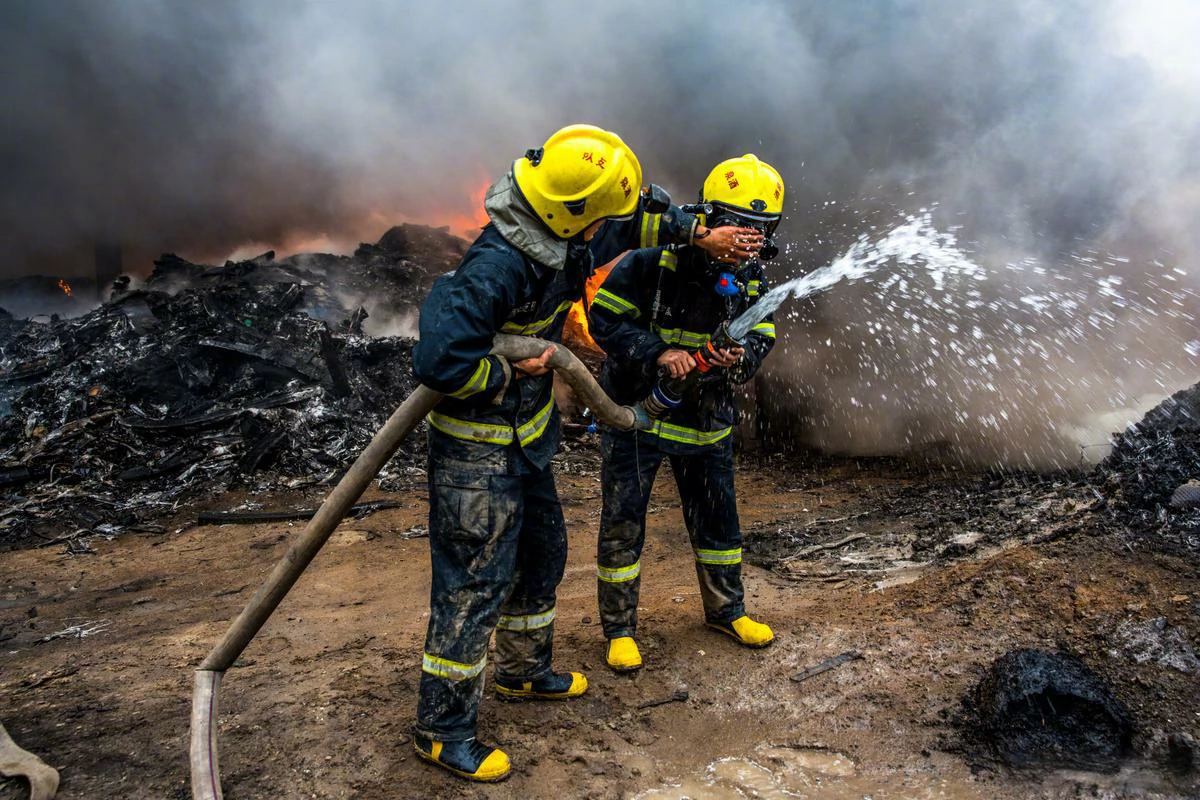
Firefighting Helmets
As a core piece of head protection equipment, firefighter helmets have evolved from early metal helmets to multi-layered composite materials primarily composed of fiberglass and carbon fiber, combined with Nomex and Kevlar linings. This ensures 2200V electrical insulation while effectively providing thermal protection for personnel’s heads at fire scenes (NFPA testing involves placing the complete helmet in an environment of approximately 260°C (500°F) for 5 minutes to examine for issues such as melting, dripping, separation, ignition, severe deformation, excessive sagging of the lower edge, chin strap failure, and visor dripping; for the chin strap, the average longitudinal shrinkage must not exceed 10%, and it must not melt, separate, or ignite). Impact protection is also crucial (NFPA helmet testing uses a 3.6 kg drop hammer at an impact velocity of approximately 5.47 m/s on the helmet; the force transmitted to the head model must not exceed 3780 N).
Depending on the type of mission, fire helmets mainly fall into three categories: structural fire helmets, technical rescue helmets (European style), and field fire helmets, as well as traditional leather helmets. Modern fire helmets can be equipped with various devices, including thermal imaging, tactical flashlights, and life detectors, and are equipped with face shields (eye shields) to further enhance head protection.
Firefighter Suits
For firefighters in a fire, the most direct and crucial protection for their bodies is their suit. Firefighter suits often give the initial impression of being thick, heavy, and rigid; this leads many to the misconception that firefighter suits are simply “thicker fire-resistant fabric.”
In fact, firefighter suits, primarily made of Kevlar, Nomex, and aramid fibers, have core requirements that can be summarized into eight aspects: thermal protection, heat dissipation, liquid barrier, compression zone thermal protection, mechanical strength, visibility, rescue functionality, durability, and maintainability.
Based on these core requirements, firefighter suits often employ a three layer structure:
Outer shell: The outermost load-bearing layer, facing flames, heat radiation, abrasion, snags, glass edges, concrete rough edges, metal sharp corners, and everyday wear and tear. The outer shell is primarily made of two materials: a blend of Nomex and Kevlar, or a blend of PBI and Kevlar.
In a fire, the outer shell must guarantee a minimum tear strength of 8 lbf (35.6 N) and must not separate or melt after 5 minutes of exposure in a furnace at 500°F/260°C (NFPA 1970:2025).
Moisture Barrier: The task of a moisture barrier is not simply to “waterproof,” but to prevent external liquids, contaminated liquids, hot water, and steam condensate from penetrating, while allowing a certain degree of moisture escape. The mainstream moisture barrier material has long been PTFE-based, typically made into a membrane/laminated structure sandwiched between the outer layer and the insulation layer.
Thermal Barrier: This layer is most commonly a combination of aramid nonwoven wadding/needle-punched/spunbond layers and a face cloth. The thermal barrier is the key layer that truly determines “how much escape margin you have under intense heat exposure,” but it is also one of the main sources of weight, stuffiness, and sluggish movement. Thicker thermal linings generally make it easier to achieve higher TPP (Total Thermal Protection); however, this also often results in a greater thermal load. Therefore, in practical applications, selection should not solely rely on the assumption that “thicker insulation equals greater safety,” but should also consider THL (Total Thermal Heating), compression zone thermal protection, mobility, and long-term operational thermal stress.
Firefighter suits are equipped with multiple attachment points to carry tactical gear such as flashlights, walkie-talkies, and quick-attack ropes. Furthermore, the suit’s color, besides compliance requirements, also enhances visibility and durability.
Firefighter Boots
In a fire, besides facing ground temperatures exceeding 100 degrees Celsius, there’s a high risk of puncture wounds from debris and sharp objects, as well as the potential for electrical shocks. In short, the worst possible conditions are always present.
Firefighting boots provide foot protection for firefighters. Based on various risks, firefighting boots designed for specific missions are characterized by high-top designs (14 inches, etc.), multi-layered construction (leather/Kevlar/PTFE), multi-layered soles (carbon fiber/steel/EVA), and rigid toe caps (steel toe, carbon fiber, fiberglass).
Depending on the mission, firefighting boots also come in various types: structural firefighting boots, wildfire firefighting boots, water rescue boots, etc.
Firefighting Gloves
Firefighting gloves are not simply about “burn protection.” In fire situations, they must address at least cut and puncture resistance, heat conduction prevention, flame spread prevention, liquid barrier properties, wrist protection, and flexibility and grip control.
Liquid barrier properties deserve special mention. NFPA documents explicitly state that some firefighting gloves use PTFE for the moisture barrier, while others use polyurethane. Furthermore, NFPA1970 2024/2025 documents emphasize that liquid penetration resistance is a core evaluation item, aiming to prevent hazardous liquids from penetrating the material or seams and entering the skin. In practice, this layer doesn’t truly protect against “rain ingress,” but rather against the dual risks of burns and contamination exposure from hot water, condensate, contaminated liquids, fuel residue, and dirty liquids.
The problem is that the more emphasis is placed on barrier properties, the more likely flexibility and moisture evacuation are to be sacrificed. Therefore, the most challenging aspect of firefighting gloves is never simply making the barrier thicker, but finding a balanced approach that doesn’t compromise on either barrier protection or flexibility.
Other Parts of Bunker Gear
Firefighting gloves are not simply about “burn protection.” In fire situations, they must address at least cut and puncture resistance, heat conduction prevention, flame spread prevention, liquid barrier properties, wrist protection, and flexibility and grip control.
Liquid barrier properties deserve special mention. NFPA documents explicitly state that some firefighting gloves use PTFE for the moisture barrier, while others use polyurethane. Furthermore, NFPA 2024/2025 documents emphasize that liquid penetration resistance is a core evaluation item, aiming to prevent hazardous liquids from penetrating the material or seams and entering the skin. In practice, this layer doesn’t truly protect against “rain ingress,” but rather against the dual risks of burns and contamination exposure from hot water, condensate, contaminated liquids, fuel residue, and dirty liquids.
The problem is that the more emphasis is placed on barrier properties, the more likely flexibility and moisture evacuation are to be sacrificed. Therefore, the most challenging aspect of firefighting gloves is never simply making the barrier thicker, but finding a balanced approach that doesn’t compromise on either barrier protection or flexibility.
What Is Bunker Gear Made Of?
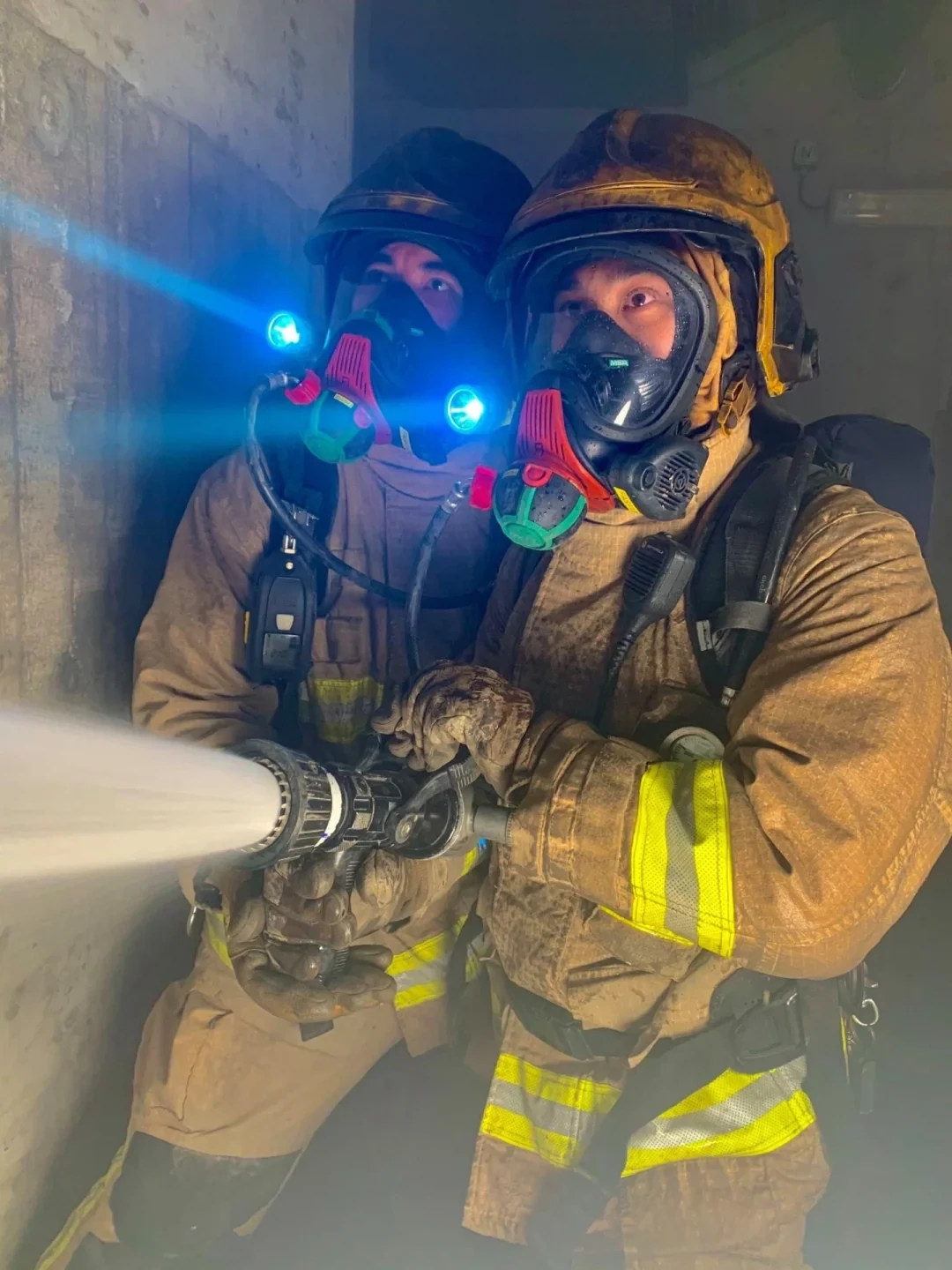
Nomex (1313 meta-aramid): Used in the outer layer of fire suits, thermal linings, hoods, and some gloves and interface fabrics. Its core characteristic is intrinsic flame retardancy; it does not lose its flame retardancy after washing and does not melt, drip, or support combustion.
Kevlar (1414 para-aramid): Used in blends for the outer layer of fire suits, reinforcing layers of thermal linings, and some high-abrasion areas of gloves. Its core characteristics are high strength, tear resistance, and abrasion resistance. Its primary function is not to provide complete insulation, but rather to enhance structural strength and durability.
PBI: Used in the outer layer of high-end fire suits and some hood fabrics. Its core characteristic is extremely high thermal stability, maintaining its shape better under high heat and flame exposure, but it is generally more expensive.
PTFE membrane: Used as a moisture barrier in fire suits and gloves, and also found in some particulate protective hood structures. Its core characteristic is strong liquid barrier capability, blocking hot water, contaminated liquids, and condensate, but it directly affects moisture permeability and heat load.
Polyurethane (PU) barrier material: Used as the barrier layer in some firefighting gloves. Its core characteristic is liquid barrier capability, while also offering some flexibility in certain structures; however, its performance is highly dependent on the composite structure design.
Lensing FR / FR Rayon (flame-retardant adhesive): Primarily used in the thermal barrier of firefighting suits and some knitted layers of hoods. Its core characteristics are improved comfort, softness, and thermal cushioning; it is often combined with aramid or PBI to balance insulation and wearing burden.
Leather: Used in some traditional firefighting helmet shells and some types of firefighting boots. Its core characteristics are heat resistance, abrasion resistance, and structural stability. In practice, its advantages lie in durability and resistance to mechanical damage in fire scenes, but it is usually heavier and requires more maintenance.
Fiberglass composites / thermoplastics: Used in modern firefighting helmet shells. The core characteristics are that the former is more impact-resistant and durable, while the latter is usually lighter; essentially, both are balancing weight, heat resistance, and impact resistance.
Rubber: Used in some firefighting boots. The core features are overall waterproofing and easy cleaning, but its value lies more in the boot’s structure and ease of maintenance than simply being “more advanced than leather boots.”
Polycarbonate: Used for SCBA face shield lenses and some eye and face protection components. Its core features are transparency and impact resistance, but it is considered one of the thermal weaknesses of the protection system under extreme heat.
Carbon fiber/glass fiber wound composite material + aluminum liner: Used for SCBA cylinders. Its core features are high strength, lightweight, and pressure resistance; its significance lies in minimizing the burden on the wearer while ensuring gas storage capacity.
How Much Does Bunker Gear Weigh?
Basic bunker gear (helmet, hood, jacket, trousers, gloves, boots, plus a self-contained breathing apparatus) typically weighs around 45–50 pounds (approximately 20–23 kg).
Different firefighting missions result in varying equipment and weights. Indoor structural firefighting/search and rescue/smoke and heat environment assault missions are the heaviest, as they usually require wearing a full structural fire suit and carrying a self-contained breathing apparatus (SCBA). In common specifications, a basic structural fire protection system (SCBA) weighs approximately 45–50 lbs (20–23 kg), while the SCBA itself typically weighs 21.6–24 lbs (approximately 9.8–10.9 kg). Therefore, when radios, lights, ropes, thermal imagers, and hand tools are added, a full assault load can easily reach 60–75 lbs (27–34 kg).
Wildfire/WUI firefighting missions do not follow the traditional “heavy bunker gear” logic, but rather the NFPA 1977/wildland PPE logic. The core focus is on reducing thermal load, improving mobility, and endurance for extended periods. Therefore, fire-retardant shirts and trousers are typically worn, rather than the three-layer turnout ensemble used in structural fires. NWCG training materials provide the following reference weights: Personal Equipment (PPE) 45 lb (21 kg), Web Gear (excluding water) 20 lb (9 kg), Total Personal Equipment 65 lb (30 kg); note that this 65 lb is not the “clothing itself,” but the total weight of personal equipment carried on the fire front.
In perimeter defense/pump operator/road accident/technical rescue/non-IDLH missions, a complete interior attack configuration is not required, nor is a full SCBA (Schooling and Backpacking) system necessarily needed. Therefore, a lighter equipment combination should be preferred.
Regarding weight, in recent years, manufacturers have been collaborating with fire departments to explore new materials, such as carbon fiber helmets and steel-toed boots.
Bunker Gear Colors
The NFPA doesn’t have specific requirements for the color of bunker gear. With advancements in firefighting technology, the main colors have become khaki, black, yellow, and red. Of course, there are also some special colors like spruce green or navy blue. I even saw someone on Reddit describe a yellow bunker gear as looking like a banana standing in a yard from a distance.
Getting back to the point, the color of bunker gear doesn’t actually differentiate them functionally. More often, it’s about better identification in a fire. Black gear more easily shows heat damage, manifesting as reddish “cracking” (let’s call it that for now). Brown gear more easily shows soot residue. Red bunker gear, on the other hand, is better for quick detection and identification in a fire.
How Long Is Bunker Gear Good For
Although NFPA 1851 specifies a lifespan of no more than 10 years from the date of manufacture for bunker gear, its actual lifespan depends on the extent of damage during missions and routine cleaning and maintenance.
In my career, I have indeed had instances where damaged fire suits were repaired and reused by “experts,” but a noticeable decline in heat protection performance was observed. This is, of course, a negative example; bunker gear is not something to be taken lightly.
Bunker gear stored for over 10 years is fine for training, but considering the adhesive and molding processes involved, its use in fire scenes is not recommended.
Bunker gear, as a core protective item for firefighters, has extremely high requirements for performance, mission adaptability, protective capabilities, portability, and durability. A suitable set of gear can not only complete the mission in a critical moment but also enable self-rescue.
Contact experts at Poseidon Fire Defense to explore the latest bunker gear technology.