
Firefighting rabbit tools are compact forcible-entry devices designed to create powerful spreading force in extremely tight gaps, where swinging tools are ineffective. Used by professional firefighters and tactical rescue teams, they are intended for controlled forcible entry on doors, gates, and light barriers—not for heavy collapse or breaching reinforced structural members. Common examples include hydraulic rabbit tools such as the Hurst Rabbit Tool and manual ram-style tools like the Hydra-Ram, both capable of initiating entry from gaps as small as 3–6 mm (≈1/8–1/4 in).
Rabbit tools convert manual or hydraulic input into high linear spreading force within a compact footprint, allowing crews to defeat locks or door frames with minimal noise and physical exertion. Compared with striking tools such as sledgehammers, they enable silent entry, reduce firefighter fatigue, and help conserve SCBA air during interior operations. Because they require little swing space and no external power source, rabbit tools are routinely carried by truck companies and interior teams operating in low visibility, tight hallways, and oxygen-limited fireground conditions, under department SOPs governing forcible-entry tactics.
What Is A Rabbit Tool In Firefighting?

A rabbit tool in firefighting is a compact hydraulic or manual forcible-entry device built to generate high spreading force in extremely tight gaps, enabling fast, controlled access when striking tools are impractical. The name “rabbit” reflects its quick, jumping action to create an initial gap and its small, portable form, especially in lighter configurations used for interior work. Typical hydraulic rabbit tools deliver up to ~8,000 lb (≈36 kN) of spreading force while weighing about 11–16 lb, allowing single-operator use in confined spaces.
Performance centers on pump-driven linear expansion—via manual or battery pumps—that produces quiet, precise force. This supports silent entry, reduces physical exertion, and helps conserve SCBA air during search and rescue. Common models include the Hurst Rabbit Tool and Hydra-Ram (Bunny Tool), both widely adopted by U.S. departments. On the fireground, rabbit tools are used to initiate purchase on inward- or outward-swinging doors, defeat locks and light gates without excessive noise, and create a clean access point for a Halligan during interior attack when swing space is limited.
How Does the Rabbit Tool Work?
A rabbit tool works by slowly pushing two metal surfaces apart using straight-line force, rather than striking or prying. Firefighters place the closed tool into a very small gap—such as between a door and its frame—then apply pressure so the tool expands outward and forces the opening wider. This method allows entry without swinging a hammer or axe, which is critical in tight interior spaces.
In hydraulic models, pressure from a hand pump or battery pump drives an internal piston. As pressure increases, the piston extends and the tool spreads with controlled force, often reaching up to 8,000 lb (≈36 kN). Manual versions use a screw or lever mechanism to achieve the same outward movement. Because the force is applied gradually and directly, the tool works quietly and with less physical effort.
On the fireground, crews use the rabbit tool to create an initial opening, defeat the lock or frame, and then insert a Halligan if a larger opening is needed. This step-by-step force application makes the tool easy to understand, precise to use, and effective under SCBA in low-visibility conditions.
Using a Rabbit Tool in the Field and Proven Model Choices
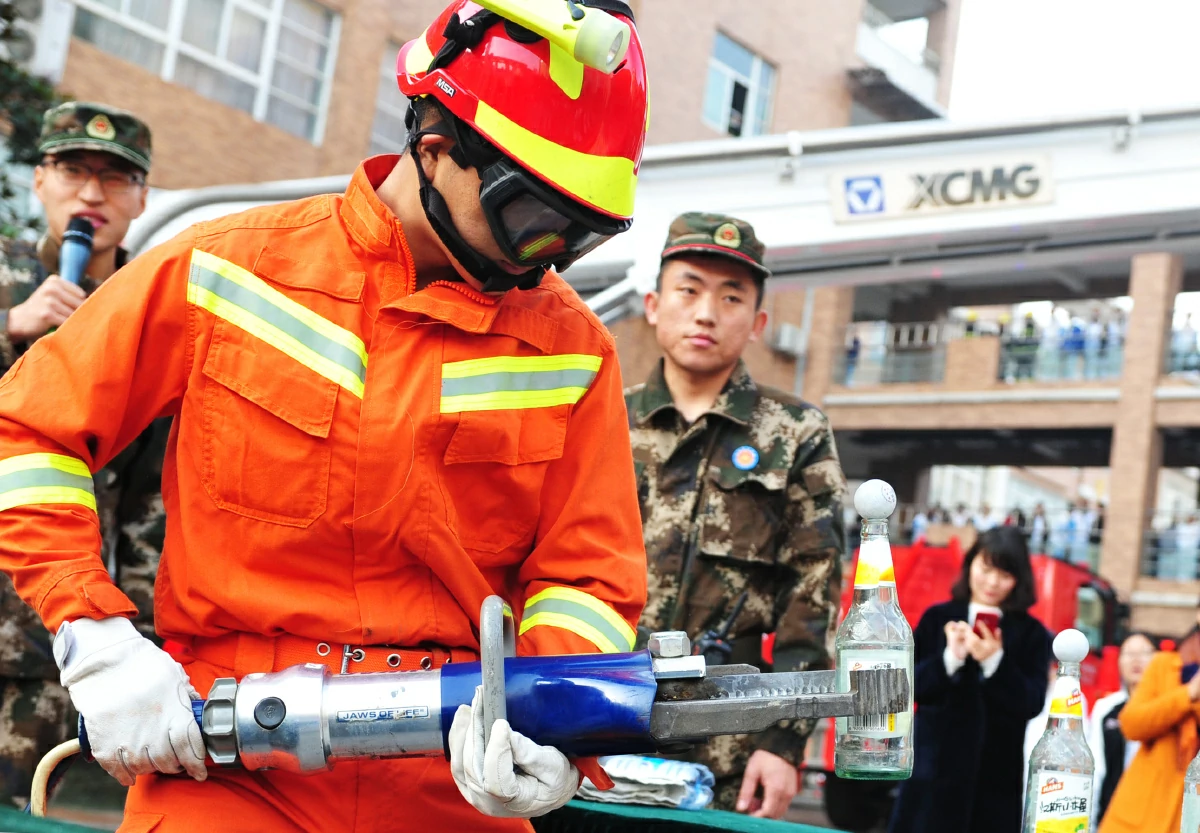
A rabbit tool is most effective when crews treat it as controlled forcible entry, then transition to irons once the lock side begins to move. It is designed for tight interior work where swing space is limited and door control matters more than impact force. Hydraulic units commonly deliver up to ~8,000 lb (≈36 kN) of spreading force, so placement and pacing drive results more than strength.
Experienced firefighters rely on three practical patterns under department forcible-entry SOPs. The first is quiet lock-side defeat: seat the tool tight at the latch, pump in short strokes, and let the frame fail without broadcasting entry. The second is purchase creation: spread just enough to bury a Halligan, then switch tools for faster door control. The third is low-effort entry under SCBA, where fewer body movements reduce fatigue and help conserve air. As with other forcible-entry tasks, rabbit tools are operated in full firefighter PPE, including firefighter gloves and eye protection, to manage pinch points and sudden hardware release.
Model choice stays practical. Hydraulic sets such as the Hurst Rabbit Tool or JL-8 Jack Rabbit are favored for speed and quiet control. Manual options like the Hydra-Ram (Bunny Tool) suit crews prioritizing simplicity and low maintenance.
Rabbit tools provide firefighters with a controlled, low-noise method of forcible entry when space, visibility, and air supply are limited. By applying high linear spreading force precisely at the lock or frame, they reduce physical strain, preserve SCBA air, and support safer interior operations under department SOPs. Used correctly and with full PPE, rabbit tools remain a reliable force multiplier for truck and engine companies.
Poseidon is a professional manufacturer specializing in firefighter forcible-entry tools, including rabbit tools and related firefighter PPE. We support OEM and private-label production, offering configurable designs aligned with U.S. fire service requirements for durability, portability, and field performance. Contact Poseidon to develop customized rabbit tools and integrated PPE solutions built for real fireground use.