
A fire is put out by applying one of the 4 methods of extinguishing fire: remove heat, remove oxygen from the oxygen supply, isolate or eliminate the fuel source, or interrupt the chemical chain reaction. These are the only valid methods of extinguishing a fire, and they apply across fire types regardless of flame size or visibility. Putting out a fire is not achieved by force, volume, or appearance alone.
Whether from a physical or NFPA fire safety perspective, effective fire suppression always operates on the basis of disrupting the fire triangle (heat source, fuel, and oxygen) or the combustion tetrahedron.A common error is assuming water will stop every fire; it fails on an electrical fire, certain metals, and class K fires, and can escalate conditions instead. Suppression methods that do not remove heat, restrict the oxygen supply, control the fuel source, or interrupt combustion predictably result in re-ignition, fire spread, equipment damage, or injury. Fire control is therefore a physics-based action, not a situational judgment call.
The Fire Triangle

A fire forms only when fire triangle heat fuel and an adequate oxygen supply are present at the same time. It is not defined by flame size, smoke volume, or visual intensity; without all three elements, combustion cannot start or continue. Any attempt at putting out a fire that fails to address at least one of these elements is ineffective by definition.
The fire triangle consists of heat, a fuel source, and oxygen. The fuel component includes combustible materials such as wood paper, textiles, or plastics that can sustain burning. Heat is the energy required to raise that fuel to its ignition temperature. Oxygen is supplied primarily by atmospheric air and enables combustion once ignition occurs.
Extinguishing fires succeeds only by remove heat, remove oxygen, or eliminate the fuel source from this system. Attempts that do not remove at least one element cannot succeed and will predictably allow the fire to continue or re-ignite. While advanced suppression science recognizes chemical interruption through dry chemical extinguishers, the fire triangle remains sufficient for field decision-making; expanded models mainly guide agent selection rather than operational judgment.
The Four Methods of Extinguishing Fire
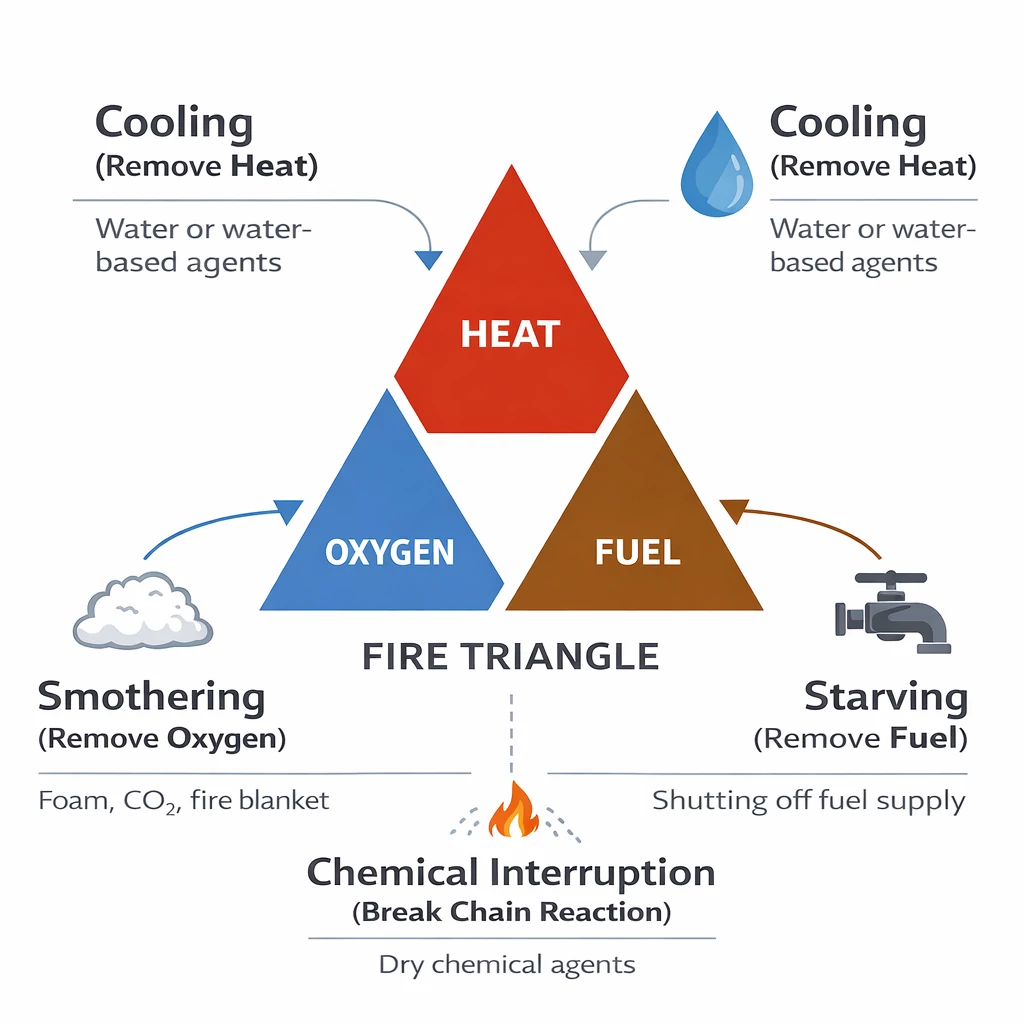
The 4 methods of extinguishing fire are cooling, smothering, starving, and chemical interruption, and each works only by removing at least one element of the class a fires triangle heat fuel and oxygen. These methods of extinguishing a fire are not interchangeable tactics; each is constrained by fuel behavior and environment. Any attempt at extinguishing fires that does not remove at least one required element cannot succeed in putting out a fire.
Cooling (remove heat)
Cooling uses water or water-based agents to remove heat from the fuel mass. It is the primary control method for fires involving ordinary combustibles, including wood paper and other cellulosic combustible materials. Cooling is not appropriate for class b flammable liquids, where water can spread the fuel source and escalate fire growth.Smothering (remove oxygen)
Smothering limits the oxygen supply at the fuel surface. Foam and a fire blanket work by sealing vapors and blocking air movement, while carbon dioxide can displace oxygen in enclosed spaces. Smothering is unreliable in open environments or where deep-seated heat remains.Starving (remove the fuel source)
Starvation controls fire by isolating or shutting off the fuel source. This method applies to controlled gas flows and process systems. It is not a substitute for suppression when exposure risk remains.Chemical interruption (break the chain reaction)
Chemical interruption stops flame propagation by disrupting combustion chemistry. Dry chemical extinguishers and other chemical fire extinguishers are effective on certain fire types, including an energized electrical fire. Chemical interruption does not cool solid fuels; re-ignition remains possible if heat and oxygen persist.
Fire Suppression Agents and Equipment
Fire suppression agents are selected by how they remove heat, separate oxygen, block fuel vapors, or interrupt the chain reaction; the equipment is only a delivery method for that agent. A single agent is sufficient only when the fuel behavior and the space match the agent’s limits, and it is not a flexible substitute across hazards. Using the wrong agent creates predictable failure modes: water cannot control a three-dimensional flammable-liquid fire, and water cannot be applied to energized equipment without shock and arc risk.
NFPA 10 class ratings exist to prevent that mismatch, and the same logic drives fixed systems under NFPA 2001 and NFPA 2010. Water and water mist remove heat from Class A fuel beds; foam adds vapor suppression and oxygen separation for Class B surfaces; dry chemical extinguishers interrupt flame chemistry but leave hot fuel capable of re-ignition; CO₂ and clean agents depend on enclosure and hold time. Condensed aerosol systems also attack the chain reaction, but they are not a universal answer in ventilated spaces, deep-seated Class A embers, or reactivity-driven metal fires.
| Suppression Agent / Equipment | Primary Mechanism | Effective Fire Classes | Key Limitations / Boundaries |
|---|---|---|---|
| Water / Water Mist | Removes heat | Class A (ordinary combustibles) | Cannot be used on energized electrical equipment or Class B flammable liquids |
| Foam | Removes heat + separates oxygen | Class A, surface Class B | Ineffective on deep 3D liquid fires without confinement |
| Dry Chemical Extinguishers | Interrupts chemical chain reaction | Class A, B, C (rated units) | Does not cool fuel; re-ignition risk remains |
| Carbon Dioxide (CO₂) | Displaces oxygen | Class B, electrical equipment | Requires enclosure; no cooling of fuel bed |
| Condensed Aerosol Systems | Interrupts chain reaction | Electrical enclosures, machinery spaces | Not suitable for ventilated areas or deep-seated Class A embers |
Incorrect selection of suppression agents and equipment produces predictable failure modes, not partial control. A fire is controlled only when at least one element is removed from the fire triangle—heat, fuel, or oxygen supply—or when the chain reaction is interrupted; attempts that do not do this cannot succeed and increase operator exposure and property loss.
Poseidon Fire Tech manufactures fire extinguishers and suppression hardware aligned with NFPA-defined use cases, including OEM/private-label programs and application-matched configurations for industrial and fire service procurement. Specify the fire types, hazards, and installation constraints, and we provide the compliant agent platform, labeling, and integration approach for your deployment environment.