

A firefighter’s Personal Protective Equipment (PPE) is not simply uniform workwear; it is an engineered life-support system designed to withstand extreme thermal flux, flashover conditions, physical abrasion, and biological pathogens. However, every structural fire response exposes this composite barrier to toxic combustion byproducts—including polycyclic aromatic hydrocarbons (PAHs), volatile organic compounds (VOCs), and heavy metals—alongside mechanical micro-tears and ultraviolet radiation.
Without a rigorous, standardized maintenance regime, turnout gear loses its thermal insulation, moisture barriers crack, and embedded carcinogens off-gas directly into firehouse quarters. Establishing a continuous maintenance protocol aligned with NFPA standards is therefore a core operational priority for department quartermasters, safety officers, and municipal fleet coordinators.
Here is the comprehensive engineering and operational guide to managing firefighter PPE throughout its service lifecycle—from routine shift inspections to certified advanced cleaning, verified field repairs, and mandatory retirement protocols.
The Regulatory Framework: NFPA 1851 and the Consolidated NFPA 1850 Standard
Historically, the care and maintenance of structural firefighting protective clothing was governed exclusively by NFPA 1851 (Standard on Selection, Care, and Maintenance of Protective Ensembles for Structural Fire Fighting and Proximity Fire Fighting). Under recent NFPA code cycles, these requirements have been consolidated under NFPA 1850 (Standard on Protective Ensembles for Structural and Proximity Firefighting and Self-Contained Breathing Apparatus), which harmonizes structural gear maintenance with SCBA inspection protocols.
The standard establishes four non-negotiable principles:
- Cancer Risk Reduction: Turnout gear must be decontaminated systematically to prevent chronic dermal absorption of carcinogenic soot. The obsolete culture of wearing soot-blackened “salty” gear as a badge of honor is explicitly identified as an extreme occupational hazard.
- Standardized Inspection Intervals: Gear must undergo multi-tiered evaluations at fixed calendar and operational intervals.
- Traceable Accountability: Every ensemble element (coat, pant, helmet, hood, glove, and boot) must possess an indelible serial number or barcode tracking all washings, repairs, and incident exposures.
- Third-Party Verification: Critical repairs and annual advanced inspections must be conducted either by trained in-house personnel verified to the standard or by an accredited Independent Service Provider (ISP).
Multi-Tier Inspection Protocols: Routine vs. Advanced
Effective PPE maintenance relies on catching structural failure before a firefighter enters an Immediately Dangerous to Life or Health (IDLH) atmosphere. NFPA standards mandate a two-level inspection architecture.
1. Routine Preliminary Inspection (Pre-Shift & Post-Incident)
Conducted by the individual firefighter before donning and immediately following exposure reduction after an operational run. This inspection takes less than five minutes but serves as the first line of defense:
- Outer Shell: Check for rips, tears, cuts, abraded seams, missing hardware (snaps, zippers, D-rings), and thermal charring or embrittlement (fabric hardening or discoloration).
- Reflective Trim: Inspect retroreflective trim for burning, cracking, or severe staining that compromises 360-degree night visibility.
- Wristlets & Collar Closures: Ensure knit wristlets retain elasticity without holes, and that the throat tab Velcro provides secure seal coverage.
- Integrity of Interfaces: Verify that interface areas between coats and firefighter pants overlap adequately during full bending and reaching motions.
2. Advanced Inspection (Annual & High-Exposure Triggers)
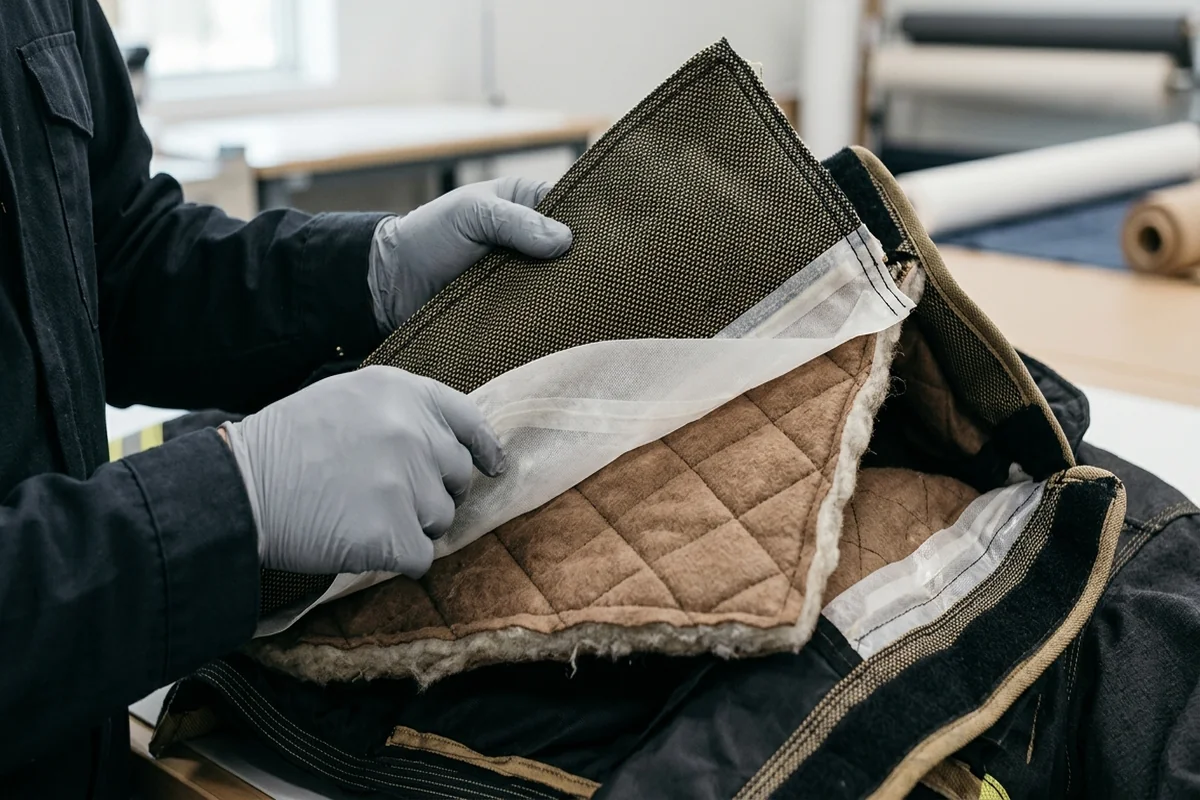
Conducted at least once every 12 months, or whenever gear has been subjected to flashover, chemical contact, or extreme physical loading. This evaluation must be performed by a designated department gear coordinator or certified ISP and requires complete deconstruction of the garment:
- Layer Separation: The outer shell, moisture barrier, and thermal liner must be separated to inspect interior surfaces.
- Light Test for Moisture Barrier: The moisture barrier (typically a breathable PTFE membrane laminated to an aramid substrate) is placed over an illuminated inspection table to detect pinholes, seam tape delamination, or membrane cracking.
- Water Penetration / Hydrostatic Evaluation: A standardized puddle or cup test (or Suter hydrostatic tester) is applied to high-flex zones (knees, crotch, elbows, shoulders) to verify liquid impermeability against fireground water and viral vectors per ASTM F1671.
- Thermal Liner Loft: Inspect quilted needle-punched batting for thinning, packing, or localized charring. Thinning liners reduce the Total Heat Loss (THL) and Thermal Protective Performance (TPP) rating of the garment.
- Structural Hardware & Closures: Verify rivet tension, zipper tooth alignment, hook-and-loop shear strength, and suspender elastic recovery.
Laundering and Decontamination: Operating Parameters for Turnout Gear
Improper cleaning destroys turnout gear faster than structural fire heat. Washing gear in domestic household machines, using high-heat commercial dryers, or applying chlorinated bleach causes catastrophic delamination of moisture barriers and breaks down aramid flame-resistant fibers.
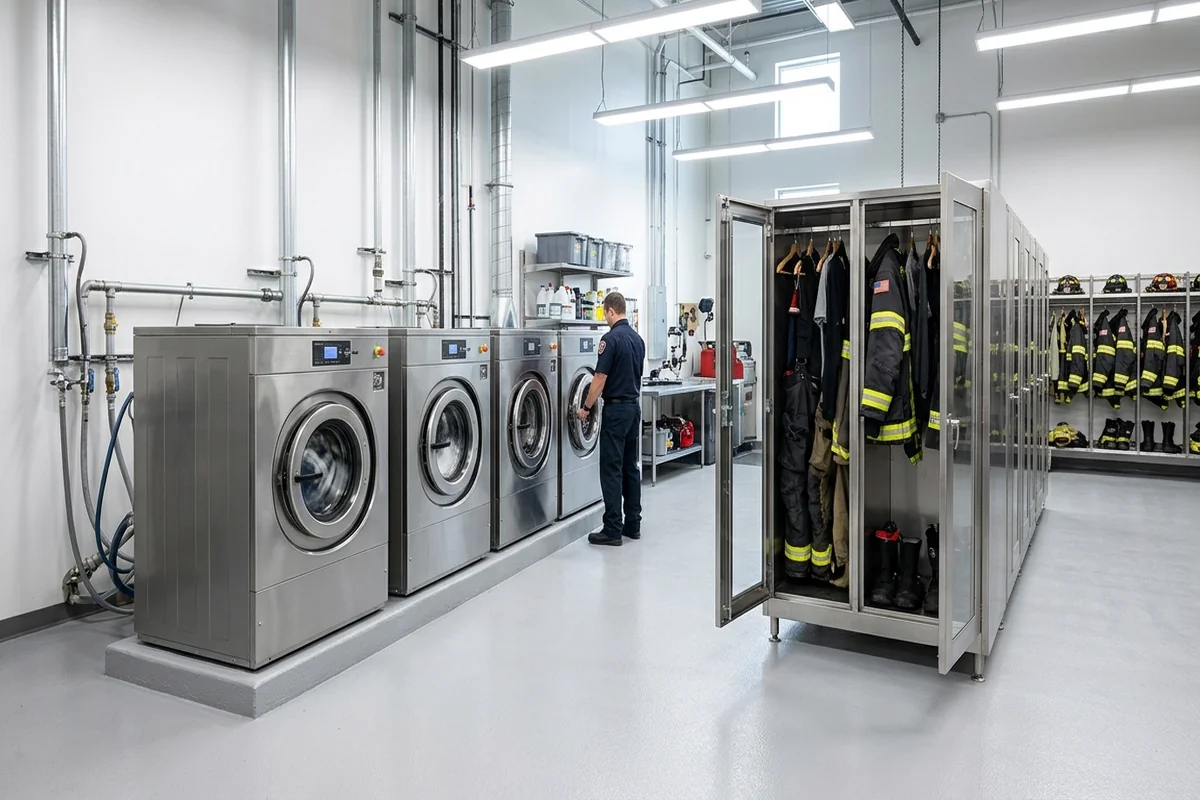
To safeguard gear integrity, departments must execute advanced laundering strictly within the following verified parameters:
1. Machine Architecture: Front-Loading Washer/Extractors
Turnout gear must only be cleaned in dedicated commercial washer/extractors designed for fire service PPE. Standard top-loading machines with center agitators snag fabric, rip storm flaps, and destroy reflective trim.
- Centrifugal Force (G-Force): The spin extraction cycle must not exceed 100 G. High G-force cycles crush the internal cell structure of thermal liners and crack seam seals.
- Water Temperature: Wash water temperature must never exceed 105°F (40°C). Excessive water heat melts moisture barrier laminates and activates thermal shrinkage in outer shells.
2. Detergent Chemistry
- Use only liquid detergents with a pH value between 6.0 and 10.5.
- Never use chlorine bleach or oxidizing additives. Chlorine chemically attacks aramid (Nomex/Kevlar) fibers, permanently stripping their tensile strength and flame resistance.
- Avoid fabric softeners, which coat fibers with flammable chemical residues that attract hydrocarbon soot.
3. Drying Protocol: Ambient Air or Specialized Cabinets
- No Direct Sunlight: Outer shell fabrics are vulnerable to ultraviolet (UV) degradation. Turnout gear must never be hung outdoors or near windows to dry. UV radiation turns aramid fibers brittle within hours.
- No High-Heat Tumble Dryers: Traditional gas tumble dryers with heated drums degrade seam adhesives and scorch moisture barriers.
- Approved Method: Gear must be air-dried in a well-ventilated, shaded decontamination room, or placed inside a dedicated turnout gear drying cabinet that circulates high-volume ambient or gently warmed air (maximum 105°F / 40°C).
Repair Boundaries: In-House Corrections vs. ISP Major Repairs
When damage is identified during routine or advanced inspection, departments must strictly enforce repair boundaries. Attempting unauthorized field repairs using non-certified materials voids manufacturer warranties and can lead to catastrophic burn injuries.
| Component / Defect | In-House Minor Repair Permitted | Mandatory ISP / OEM Major Repair |
|---|---|---|
| Outer Shell Minor Snag / Small Tear | Permitted if tear is < 1 inch (25 mm) outside critical stress zones, using matching NFPA 1971 certified Nomex/Kevlar thread and patch material. | Tears > 1 inch, tears along major structural seams, or replacement of entire pocket/cuff assemblies. |
| Moisture Barrier Damage | Strictly Prohibited. Field stitching punctures the waterproof membrane. | Mandatory ISP repair using authorized thermo-seal welding tape and hydrostatic verification. |
| Thermal Liner Tears | Minor stitching of non-structural face-cloth rips using certified aramid thread. | Patching or replacement of needle-punched batting or moisture-barrier quilted seams. |
| Hardware Replacement | Replacement of suspender buttons or exterior Velcro tabs using approved patterns. | Zipper track replacement, harness D-ring anchor stitching, or DRD (Drag Rescue Device) repairs. |
| Reflective Trim | Restitching loose trim edges. | Replacement of damaged retroreflective stripes across chest, hem, or cuffs. |
All repair materials—including thread, fabric patches, zipper tracks, and hook-and-loop fasteners—must carry verified certification to NFPA 1971 standards. Standard nylon or polyester craft thread will instantly ignite and melt during interior fire attack.
Mandatory Retirement Criteria and the 10-Year Benchmark
NFPA 1851 enforces an absolute retirement threshold: All structural firefighting ensemble elements must be retired from service no later than 10 years from the date of manufacture.
This 10-year rule is non-negotiable regardless of how pristine the gear appears on the outside. Even if a coat hung inside a backup locker and responded to few calls, microscopic degradation of moisture barriers, thermal batting compaction, and elastomeric breakdown permanently reduce protective margins over a decade.
Immediate Retirement Triggers (Prior to 10 Years)
Gear must be pulled from frontline emergency service and permanently decommissioned immediately if it exhibits any of the following failure modes:
- Unrepairable Thermal Damage: Generalized charring, embrittlement, or melting of the outer shell fabric resulting from direct flame impingement or flashover exposure.
- Moisture Barrier Failure Across Multiple Zones: Generalized hydrostatic failure where water or viral fluids penetrate through the membrane in three or more test zones.
- Severe Chemical or Hazardous Contamination: Exposure to toxic chemicals, radioactive materials, biological warfare agents, or heavy hydrocarbon saturation that cannot be removed through verified ISP advanced cleaning.
- Altered Fit or Loss of Interface: Shrinkage exceeding 5% that exposes the firefighter’s wrists, ankles, or midriff during standard ergonomic articulation.
Note on Training Cascading: Gear retired strictly due to the 10-year rule may be repurposed for non-live-fire, non-IDLH recruit drills (e.g., ladder carries, hose deployment, medical scenarios), provided it is permanently stenciled with bold, indelible red lettering: “TRAINING ONLY – NO LIVE FIRE ENTRY”.
Lifecycle Tracking and Digital Documentation
OSHA regulations and NFPA standards mandate complete historical traceability for every piece of structural gear. A compliant department PPE management system tracks the complete lifecycle profile of each item:
- Asset Master Record: Element type, manufacturer, model name, unique serial number/barcode, date of manufacture, size, date placed into service, and assigned firefighter ID.
- Operational Log: Date and nature of each fire incident exposure, noting heavy smoke, hazmat proximity, or structural flash events.
- Maintenance History: Exact dates of every routine inspection, annual advanced inspection, machine cleaning cycle, water penetration test result, and certified repair invoice.
- Decommissioning Record: Final retirement date, trigger reason (10-year milestone vs. irreparable damage), and certified disposal or cascading method.
Automated barcode tracking significantly reduces administrative overhead while providing bulletproof legal and safety documentation during municipal audits and line-of-duty health investigations.
Technical Summary & Action Checklist
Protecting the protective ensemble requires structured discipline across all operational echelons:
- Shift Routine: Inspect outer shell, reflective trim, and interface seals before and after every structural run.
- Post-Fire PER: Perform gross on-scene decontamination and wet-wiping before loading gear into apparatus compartments.
- Dedicated Laundry: Machine-wash exclusively in front-load extractors at ≤ 100 G, ≤ 105°F water, and neutral pH detergent. Never expose wet gear to direct sunlight.
- Annual Advanced Verification: Conduct full deconstructed liner and hydrostatic testing every 12 months.
- Enforce Hard Retirement: Retire all elements at 10 years from the date of manufacture without exception.
For technical specifications on certified structural ensembles, moisture barrier technologies, and industrial protective clothing, explore Poseidon’s comprehensive Firefighter PPE and Structural Firefighter Turnout Gear technical resources.