

Structural firefighting PPE is designed to provide limited protection against the thermal, physical, and other hazards encountered during structural firefighting. Coats, pants, helmets, gloves, boots, and hoods cover different parts of the body. Personal protective equipment (PPE) must fit correctly and work with the breathing apparatus and other equipment used for the task.
Turnout clothing provides a protective barrier within its tested limits. Under the structural firefighting requirements now consolidated in NFPA 1970, formerly NFPA 1971, turnout gear—including the outer shell, moisture barrier, and thermal liner—must meet strict performance benchmarks to assess thermal protection. Protective clothing can also increase heat stress by restricting heat loss.
Breathing apparatus (SCBA) provides respiratory protection, while personal alert safety systems (PASS) help signal firefighter distress. Protective clothing alone does not supply breathable air or eliminate burn and heat-stress risks.
This article breaks down what protective clothing includes, how fire departments can ensure their equipment aligns with NFPA 1970 and the relevant earlier NFPA 1971 edition, and why adherence is essential for reducing the risk to those who perform their duties on the front lines of the fire service.
PPE Standards in the U.S. Fire Service
NFPA 1970 (2025) is the current consolidated product standard for structural and proximity firefighting protective ensembles, work apparel, open-circuit SCBA, and PASS. It combines the former NFPA 1971, NFPA 1975, NFPA 1981, and NFPA 1982 standards. NFPA’s standard-development page identifies the current edition; earlier numbers remain relevant when reading existing product labels and purchasing specifications.
NIOSH respirator approval under 42 CFR Part 84 is a separate requirement from NFPA product certification. Departments should identify the standard edition required by their purchasing authority and check the selected product’s listing, configuration, and instructions. Publication of a new standard does not automatically change every jurisdiction’s legal requirements or certify an existing product to that edition.

NFPA PPE Standards by Component
| PPE Component | Current Standard / Earlier Reference | Purpose & Notes |
| Turnout gear (coat & pants) | NFPA 1970 (formerly NFPA 1971) | Specifies garment design, thermal and barrier performance, testing, and certification requirements. |
| Helmet | NFPA 1970 (formerly NFPA 1971) | Provides head protection within the tested performance limits. |
| Gloves | NFPA 1970 (formerly NFPA 1971) | Provides cut, puncture, and thermal protection for the hands. |
| Boots | NFPA 1970 (formerly NFPA 1971); applicable footwear requirements | Covers toe impact, sole puncture resistance, and thermal durability. |
| Protective Hood | NFPA 1970 (formerly NFPA 1971) | Provides limited protection at the coat, helmet, and SCBA facepiece interface. |
| Eye Protection | Applicable eye/face protection requirements and ensemble interfaces | Select for the task and check compatibility with the helmet and SCBA facepiece. |
| Breathing Apparatus (SCBA) | NFPA 1970 (formerly NFPA 1981); NIOSH 42 CFR Part 84 | Covers breathing-apparatus performance; approval and fit must match the complete configuration. |
| Personal Alert Safety Systems (PASS) | NFPA 1970 (formerly NFPA 1982) | Signals distress, including an alarm after a period of wearer immobility. |
Ensemble Certification
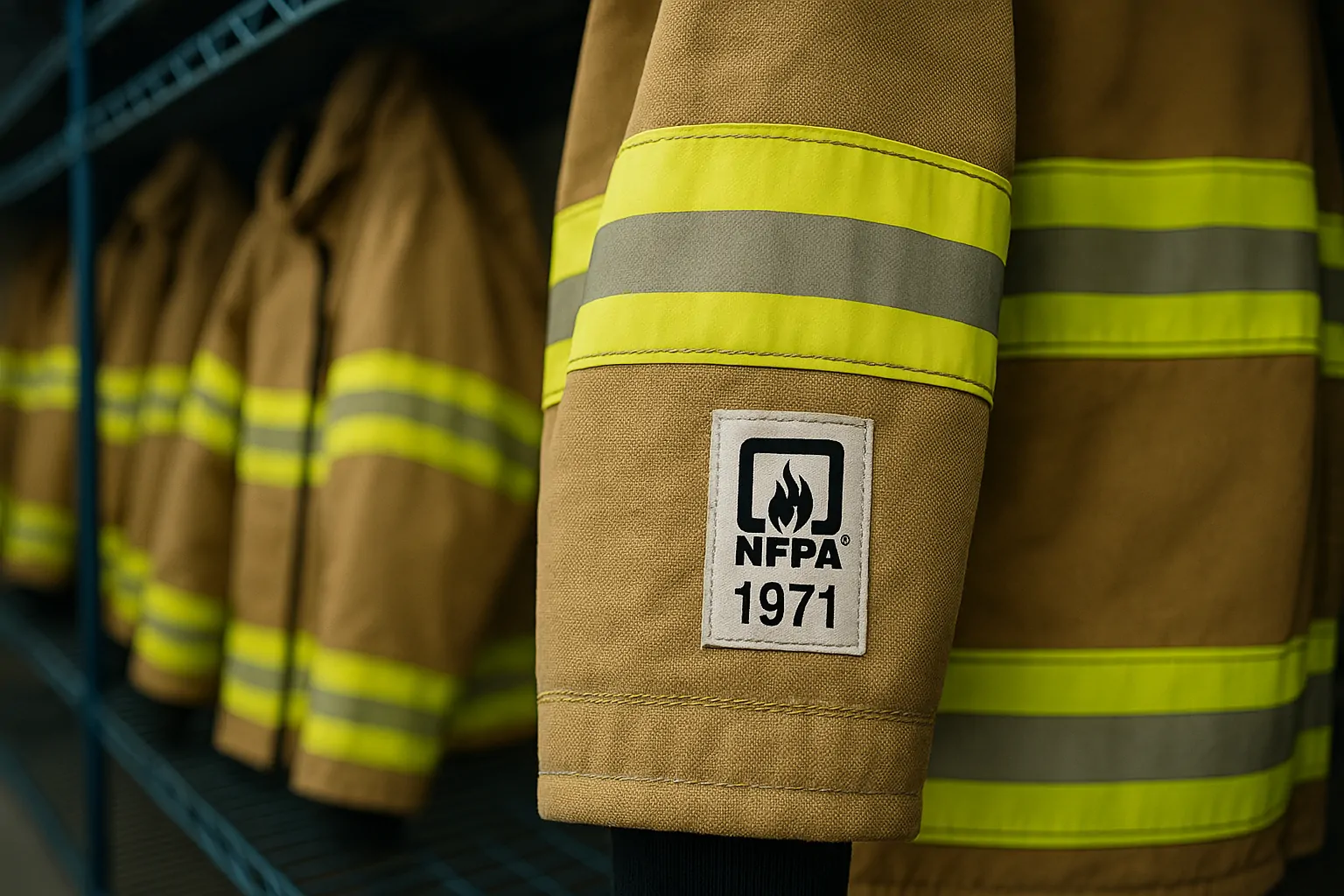
NFPA 1970 includes certification requirements for protective ensembles and individual ensemble elements. Certification applies to the listed product and configuration. It does not mean that every combination of separately certified garments, helmets, gloves, boots, and SCBA has been tested together as one complete system.
Check the certification organization’s listing and the product label for the model, applicable edition, and covered configuration. A laboratory test report and a product certification listing serve different purposes. Follow the manufacturer’s instructions when checking fit and interfaces; an “NFPA-style” description alone is not evidence of certification.
International PPE Standards Beyond the U.S.
While NFPA 1970, which includes the former NFPA 1971 requirements, forms the foundation for firefighter PPE in the United States, fire services around the world rely on their own national standards—many of which reflect similar goals for thermal protection, durability, and operational safety, but differ in scope, test procedures, and certification pathways.
EN 469(Europe)
Issued by the European Committee for Standardization (CEN), EN 469 is the core standard for protective clothing used in structural fire operations across the EU. The standard measures performance across several categories:
X1/X2 – Heat and flame performance
Y1/Y2 – Water penetration resistance
Z1/Z2 – Water vapor resistance (breathability)
EN 469:2020 distinguishes Level 1 and Level 2 by heat and flame performance. Level 2 covers risks from firefighting and rescue in structures; Level 1 covers outdoor firefighting and support activities and is not sufficient on its own for structural firefighting. Y and Z are additional grades for water penetration and water-vapor resistance. The standard’s published scope explains these distinctions. Clothing placed on the EU market must follow the applicable requirements of EU Regulation (EU) 2016/425. NFPA and EN 469 use different test and certification frameworks, so their ratings should not be treated as interchangeable.
AS/NZS 4967 & 4821(Australia / New Zealand)
AS 4967:2019 covers protective clothing for structural firefighting and supersedes AS/NZS 4967:2009. AS/NZS 4821:2014 covers protective footwear for firefighters, based on EN 15090:2012 with modifications. It is a footwear standard, rather than a general standard for wildland clothing.
Purchasers should distinguish the garment standard from the footwear standard and check the specified edition, intended activity, and product documentation. Certification to one of these standards does not establish NFPA or EN 469 compliance.
GA 10 & GA 634(China)
China’s firefighting standards include XF 10-2014 for firefighting protective clothing, formerly GA 10-2014, and XF 44-2015 for fire helmets, formerly GA 44-2015. The Ministry of Emergency Management renumbered these firefighting standards from GA to XF while retaining their sequence numbers, years, and content. GA 634-2015, now XF 634-2015, concerns heat-insulating protective clothing, rather than helmets.
Key focus areas include:
Flame resistance and tear strength
Seam strength and thermal insulation
Retroreflective striping and visibility in low light
Chinese product-standard conformity does not automatically establish NFPA or EN certification. Check the standard, edition, product scope, and certification documentation for the intended market.
Why Standards Matter in Firefighter PPE
Firefighter PPE standards establish minimum design, performance, testing, and certification requirements for specific equipment. These requirements allow purchasers to compare documented products within the same standard and edition.
Certification does not eliminate every fireground hazard or guarantee that equipment will prevent injury in all exposures. Thermal protection, fit, interface coverage, inspection, maintenance, training, and the operating conditions all affect protection. Protective clothing can also increase the wearer’s heat burden.
Legal requirements and grant eligibility depend on the applicable rule, jurisdiction, and program. For example, OSHA’s fire-brigade rule has its own scope and incorporated references; it does not simply require every product to meet the latest NFPA edition. Departments should check the requirements governing their operation and purchase.
Standards turn gear into protection, and protection into trust. Without certified, well-integrated NFPA PPE, even the best training can be undermined by equipment failure.
Whether you’re equipping a new recruit class, reviewing your department’s compliance, or preparing for your next AFG grant cycle, understanding firefighter PPE standards isn’t just helpful—it’s essential.
Poseidon supplies structural and wildland firefighting PPE and supports OEM sourcing and customization. The applicable standard, certification scope, and available configuration depend on the selected product. Discuss the target market and required edition with the PPE team before specifying an order.
Talk to one of our PPE specialists today to discuss product selection, the required standard edition, and configuration for your order.