

A fire extinguisher cabinet should protect the extinguisher without making it harder to find, inspect, or remove in an emergency. The first selection point is usually not material or price, but fit: the cabinet must match the extinguisher size, wall condition, mounting method, traffic path, and project requirements.
A cabinet that is too small can slow removal, while a surface-mounted unit that projects too far into a circulation path may create an accessibility or clearance issue. Before purchasing, confirm the extinguisher dimensions, surface-mounted, semi-recessed, or recessed installation method, applicable ADA protrusion limits, door and lock requirements, signage needs, and any local fire or building code requirements for the facility.
Start With Extinguisher Size and Cabinet Fit
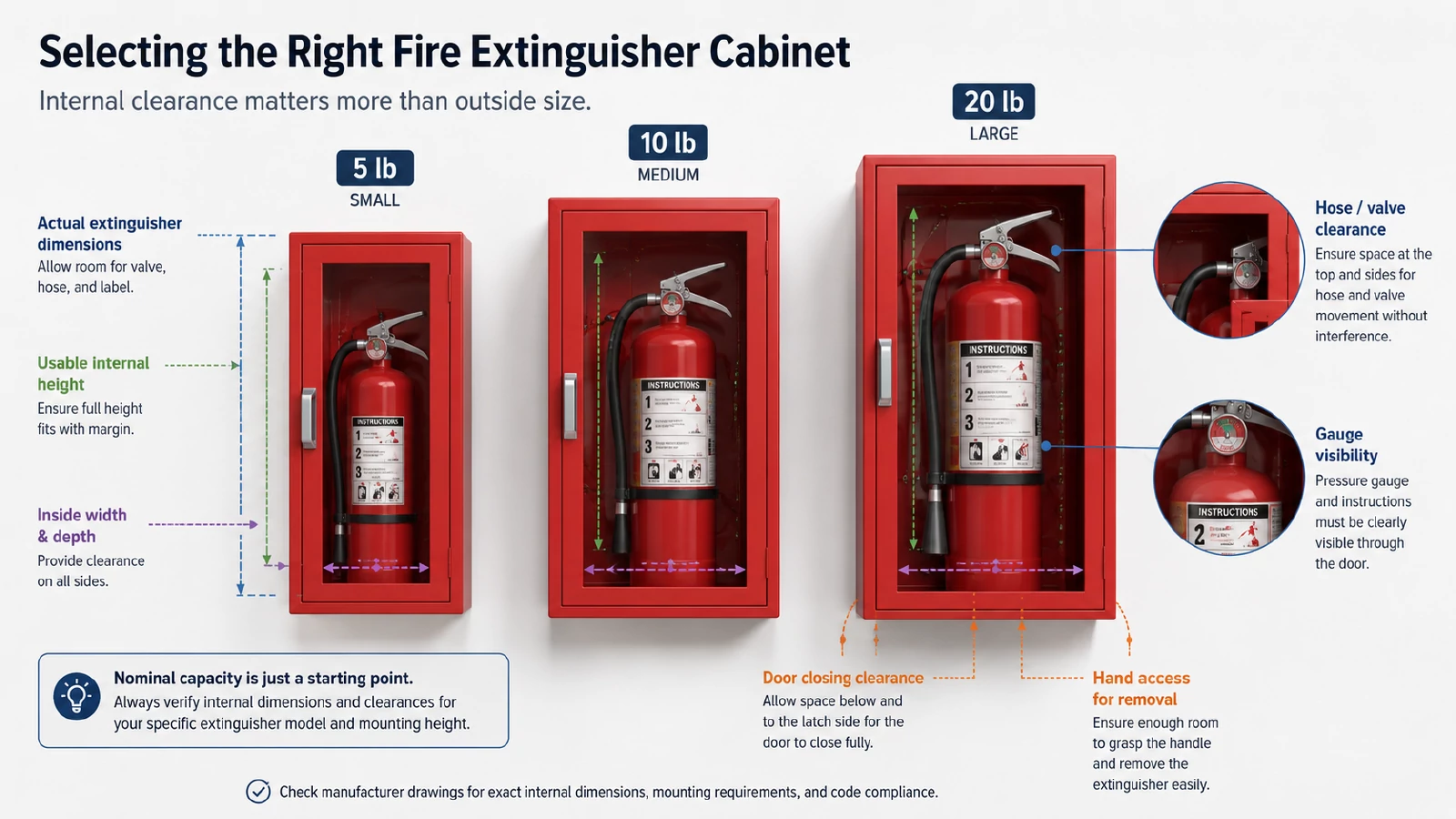
Cabinet selection should start with the actual extinguisher dimensions, not only the nominal capacity. Common cabinet fit categories often include 5 lb, 10 lb, and 20 lb extinguishers, but these labels are only a starting point. A 10 lb extinguisher from one model series may have a different overall height, cylinder diameter, hose position, valve layout, or handle clearance than another 10 lb unit.
Fit should mean more than whether the extinguisher can be placed inside the cabinet. The cabinet needs enough usable internal clearance for the extinguisher to sit securely, the door to close without pressure on the hose, valve, or gauge, and personnel to remove the unit quickly during an emergency. Outside cabinet dimensions should not be used as the only reference; internal clearance should be confirmed by the cabinet drawing, extinguisher data sheet, or sample fit.
Cabinet capacity should not be treated as universal compatibility. If the pressure gauge, label, inspection tag, operating instructions, or access to the pull pin is blocked by the frame, door, or glazing design, routine inspection and emergency use may be affected.
- Confirm the extinguisher’s actual overall height and compare it with the cabinet’s usable internal vertical clearance.
- Check cylinder diameter against the cabinet’s inside width and depth, not only the outside cabinet size.
- Review hose, nozzle, valve, gauge, and handle layout to avoid pressure against the door or glazing.
- Make sure the door can close fully without bending the hose or contacting the valve assembly.
- Keep the pressure gauge, label, inspection tag, and operating instructions visible for routine checks where required.
- Allow enough hand access for fast removal, especially in recessed or semi-recessed installations where the frame may reduce usable opening space.
Choose the Right Mounting Type
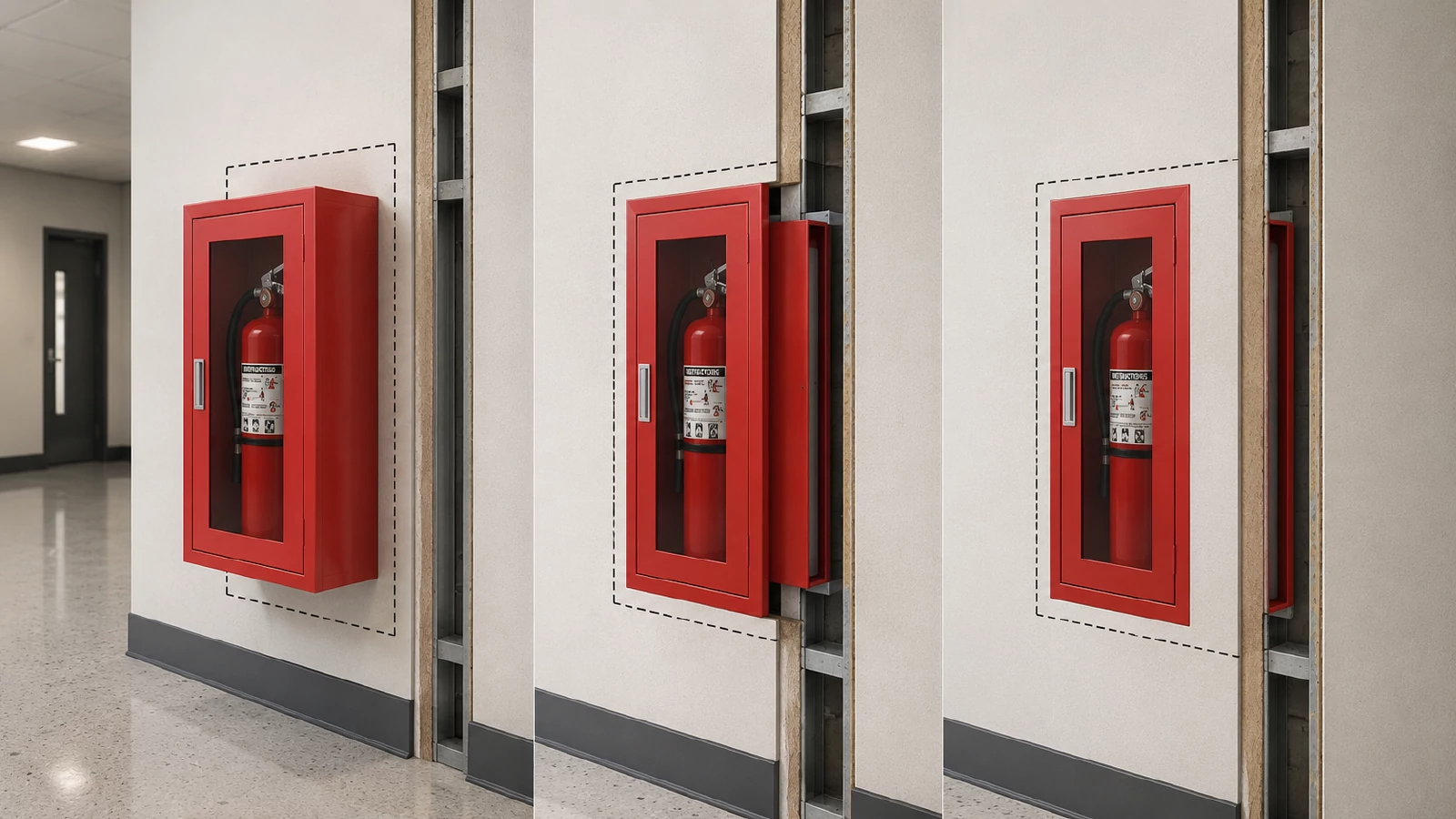
Mounting type affects wall projection, installation cost, and project approval risk, so it should be decided before material or door style. The key question is not only where the cabinet looks best, but whether the selected installation method fits the wall structure, circulation path, construction stage, and applicable code requirements.
As a reference, ADA protruding-object rules may limit wall-mounted objects with leading edges more than 27 in. (685 mm) and not more than 80 in. (2030 mm) above the finished floor to a maximum horizontal projection of 4 in. (100 mm) into circulation paths. This does not mean every surface-mounted cabinet is noncompliant, but it does mean projection should be checked when cabinets are installed in corridors, aisles, or other circulation paths.
| Mounting Type | Main Advantage | What to Check | Suitable Use |
| Surface-mounted | Easier installation and simpler replacement | Wall projection, required clear width, mounting height, and whether the location is in a circulation path | Utility rooms, back-of-house areas, mechanical spaces, or locations where projection is acceptable |
| Semi-recessed | Reduces projection compared with surface-mounted cabinets | Wall opening, available wall depth, trim design, and remaining projection after installation | Corridors, commercial interiors, and projects where projection must be controlled but full recess is not feasible |
| Fully recessed | Provides the lowest wall projection | Rough opening, stud layout, wall depth, fire-rated wall requirements, and finish coordination | New construction, finished corridors, and space-limited circulation paths where wall conditions support recessed installation |
The right choice depends on wall structure, corridor layout, project stage, and applicable fire, building, and accessibility requirements. Semi-recessed and fully recessed cabinets are often used where projection must be reduced, but recessed installation is not automatically better. Wall depth, framing, wall rating, finish work, and labor cost can all affect feasibility. For renovation projects, retrofitting recessed cabinets is usually more complex than specifying them during new construction, so the mounting type should be confirmed early with project drawings, cabinet rough opening data, and site conditions.
Check ADA Projection and Accessibility Requirements
ADA compliance should be checked as an installation and protruding-object issue, not simply as a cabinet style label. Under ADA Standards, objects with leading edges more than 27 in. (685 mm) and not more than 80 in. (2030 mm) above the finished floor or ground are generally limited to a maximum horizontal projection of 4 in. (100 mm) into circulation paths. This rule is not written specifically for fire extinguisher cabinets, but it can directly affect cabinets installed in corridors, public routes, or other circulation paths. Surface-mounted cabinets often require closer review because they usually project farther from the wall.
“ADA compliant” should not be used as a broad product claim without checking the actual installation. A recessed or semi-recessed cabinet may help reduce projection, but compliance still depends on the final installed projection, including trim, frame, door hardware, mounting height, wall condition, and the project’s accessibility requirements. ADA is also not the only reference point. Local building code, fire code, AHJ review, architectural drawings, and facility-specific requirements should be confirmed before purchase, especially in schools, healthcare buildings, public facilities, offices, and commercial interiors.
Compare Cabinet Materials by Installation Environment
The right cabinet material depends on the installation environment more than on general durability claims. A fire extinguisher cabinet used in a dry office corridor does not face the same risks as one installed in a coastal facility, washdown area, parking structure, warehouse, or outdoor service zone. Material choice should consider moisture, cleaning frequency, corrosion exposure, impact risk, temperature, visibility, and maintenance access, not appearance alone.
For most indoor commercial projects, painted or carbon steel cabinets are commonly used where cost, rigidity, and routine durability must be balanced. Stainless steel may be more appropriate where moisture, cleaning chemicals, coastal air, or corrosion risk are higher, but it should not be described as corrosion-proof. Where stainless grade is specified, 304 and 316 are common reference options, with 316 often considered for higher chloride or coastal exposure; final selection should follow project specifications and supplier documentation.
Plastic cabinets can be useful in damp, corrosive, or selected outdoor environments, provided UV resistance, temperature range, impact exposure, and project code requirements are confirmed. Aluminum can reduce weight, but its real performance depends on sheet thickness, cabinet construction, surface finish, and door hardware. Material selection should therefore be reviewed together with the installation environment, maintenance expectations, and supplier data, not based on appearance or material name alone.
| Material | Suitable Environment | What to Confirm | Main Risk if Wrong |
| Painted steel | General indoor commercial use where moisture and chemical exposure are limited | Coating type, coating condition, exposed edges, and expected cleaning frequency | Scratches, chipped coating, or cut edges may expose the cabinet to corrosion risk |
| Stainless steel | Humid, washdown, coastal, healthcare, food-processing, or higher-corrosion areas | Stainless grade, finish, fasteners, hinge material, and chloride or chemical exposure | Better corrosion resistance than painted steel, but not rust-proof in all environments |
| Aluminum | Lightweight or corrosion-conscious installations where moderate impact risk is expected | Sheet thickness, frame design, surface finish, hinge, latch, and door rigidity | Strength, dent resistance, and long-term performance depend on construction, not material name alone |
| Plastic | Damp, corrosive, or selected outdoor areas where metal corrosion is a concern | Resin type, UV resistance, manufacturer temperature range, impact exposure, and code suitability | UV exposure, heat, cold, impact, or unsuitable resin may reduce service life or acceptance |
| Decorative wood | Interior design-sensitive spaces with low abuse and controlled indoor conditions | Fire and building code acceptance, finish durability, mounting method, and maintenance access | Limited suitability for industrial, humid, public, or high-traffic B2B applications |
Review Fire-Rated Options, Visibility, and Signage
Fire-rated cabinet options, extinguisher visibility, and signage should be reviewed before purchase when the cabinet is used in a commercial project with rated walls, public access, inspection routines, or code review. A fire-rated cabinet may be relevant when a recessed or semi-recessed cabinet is installed in a fire-resistance-rated wall assembly and the wall rating must be maintained. This should not be simplified as “the cabinet can resist fire for a certain time” unless the rating, product listing, wall assembly, and installation method support that claim.
For daily use and inspection, the extinguisher must remain visible, accessible, and unobstructed. If the extinguisher is not clearly visible inside the cabinet, or if the cabinet location is not immediately obvious, conspicuous marking, signage, arrows, or other identification may be needed to support faster recognition during an emergency. Final requirements should follow the project documents, local code, NFPA reference requirements where applicable, and AHJ review.
- Confirm whether the cabinet will be installed in a fire-resistance-rated wall assembly before selecting fire-rated options.
- For recessed or semi-recessed cabinets, check whether the installation creates a membrane penetration that must be protected.
- Verify fire-rated claims through product documentation, listing information, wall assembly compatibility, and manufacturer installation instructions.
- Check that the extinguisher, pressure gauge, label, operating instructions, and inspection tag remain visible or accessible after installation.
- Make sure the door, trim, lock, glazing, handle, or latch does not delay emergency access.
- Use signage as an identification measure, not as a decorative accessory.
- Review local code, project specifications, AHJ requirements, and facility standards before final approval.
Fire-rated, signage, and visibility requirements can vary by jurisdiction and project type. The safer approach is to match the cabinet to the wall condition, access route, inspection process, and approved project documents instead of relying on a generic cabinet description.
Before ordering a fire extinguisher cabinet, do not rely on the cabinet label alone. Confirm the extinguisher’s actual dimensions, usable cabinet clearance, installation location, wall condition, mounting type, and applicable projection limits first. Then match the material to the environment, including indoor commercial use, moisture exposure, corrosion risk, impact risk, cleaning frequency, or outdoor exposure.
For projects with rated walls, public access, or formal code review, also confirm whether a fire-rated cabinet option or listed installation detail is required, whether the extinguisher remains visible and accessible, and whether signage is needed. Final approval should follow local code, project specifications, approved drawings, and AHJ confirmation rather than a generic cabinet description.
Frequently Asked Questions
Find quick answers about product selection, installation, compliance, and customization.
What size fire extinguisher cabinet do I need?
Choose the cabinet by the extinguisher’s actual dimensions, not capacity alone. Common cabinet categories include 5 lb, 10 lb, and 20 lb extinguishers, but fit should be confirmed by overall height, cylinder diameter, hose position, valve layout, handle clearance, and cabinet inside dimensions. Capacity labels should not be treated as universal compatibility.
Are surface-mounted fire extinguisher cabinets ADA compliant?
A surface-mounted cabinet is not automatically non-compliant, but it may create a protruding-object concern because it projects farther from the wall. In circulation paths, wall-mounted objects with leading edges more than 27 in. (685 mm) and not more than 80 in. (2030 mm) above the finished floor are generally limited to 4 in. (100 mm) of horizontal projection. Actual compliance depends on the final installation.
Is a recessed fire extinguisher cabinet always required?
A recessed fire extinguisher cabinet is not required for every project. It is often used in corridors, public circulation areas, ADA-sensitive locations, or space-limited routes where wall projection must be reduced. The final choice depends on local code, wall construction, project drawings, accessibility requirements, and AHJ review.
Which material is best for a fire extinguisher cabinet?
There is no single best material for every installation. Painted steel is common for general indoor commercial use. Stainless steel offers better corrosion resistance in humid or higher-risk environments, but it is not rust-proof. Aluminum is lighter than steel, while plastic may suit selected outdoor, damp, or corrosive locations if UV resistance, temperature range, impact exposure, and code suitability are confirmed.
When do I need a fire-rated fire extinguisher cabinet?
A fire-rated cabinet is usually considered when the cabinet is installed in a fire-resistance-rated wall assembly and the wall rating must be maintained. This should be confirmed through product listing, installation instructions, wall type, project specifications, and code review. It should not be described as a standalone fire-resistance promise without documentation.
Do fire extinguisher cabinets need signs?
Signs may be needed when the extinguisher location is not immediately obvious, the cabinet door reduces visibility, or facility inspection and emergency response procedures require clearer identification. Signage requirements should be checked against local code, facility policy, inspection practice, and project specifications. Not every cabinet automatically requires a separate sign.