
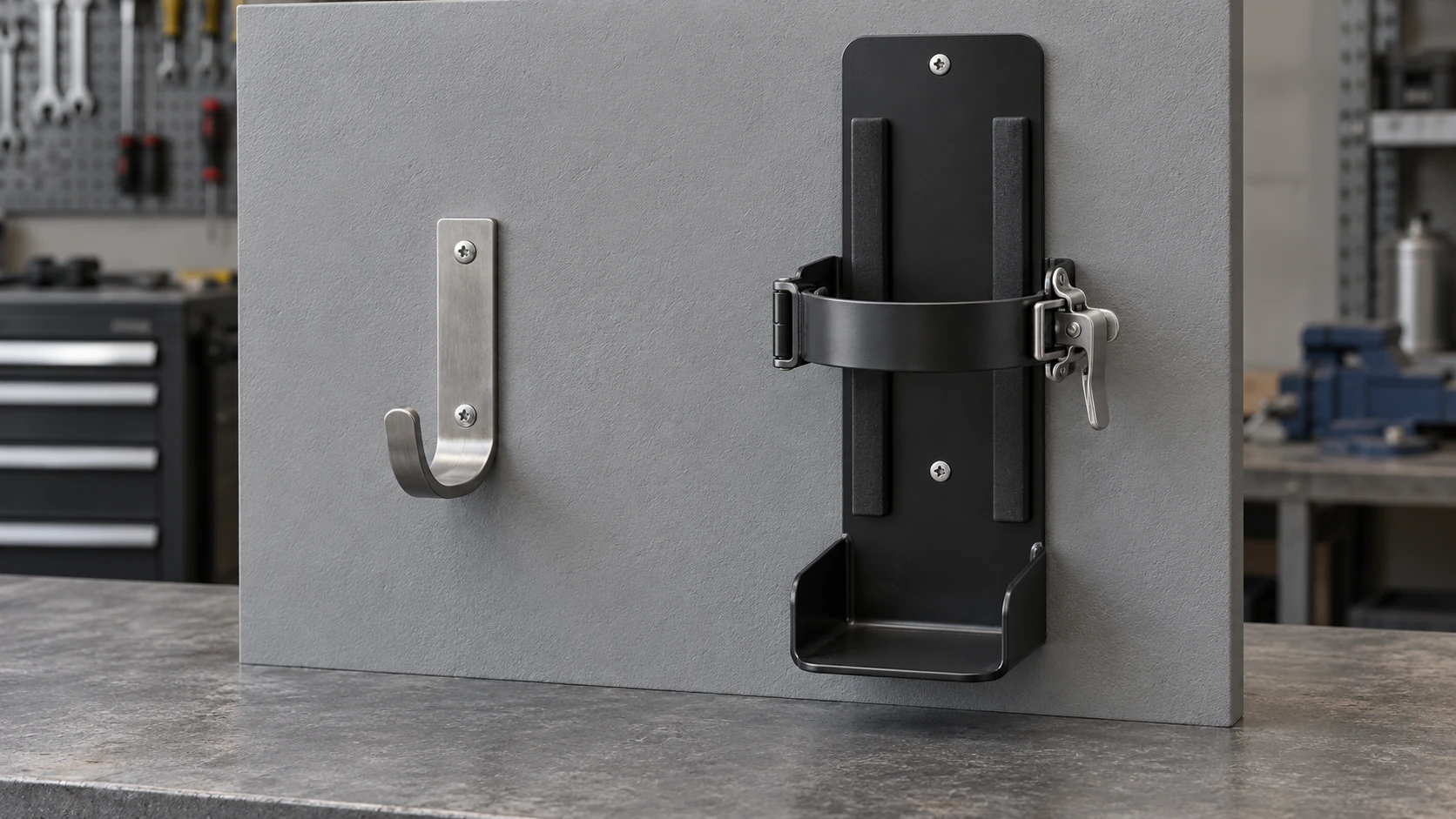
Vehicle suitability depends on the manufacturer’s stated application and the actual extinguisher-and-bracket combination. A wall hook carrying an upright extinguisher’s weight does not, by itself, demonstrate retention during vehicle movement. Some retained mounts serve both fixed and mobile locations, so the word “wall,” a visible strap or a capacity label cannot settle the choice alone.
Support and Retention Address Different Loads
| Dimension to compare | Typical open wall hanger at a fixed location | Manufacturer-designated retained vehicle mount |
|---|---|---|
| Function to verify | Support and engagement for fixed-location use | Support and restraint for the stated mobile application |
| Movement to assess | Routine handling and accidental disturbance at the site | Motion and dislodgement in the intended vehicle and orientation |
| Removal arrangement | Clearance to lift or disengage the actual unit | Access and clearance to release the restraint, then withdraw the unit |
| Fit basis | Specific hanging feature, body geometry and charged unit weight | Specific cylinder and support geometry, charged unit weight and closure engagement |
| Installation evidence | Manufacturer’s instructions and suitable attachment | Manufacturer’s instructions, stated application and permitted orientation, with suitable attachment |
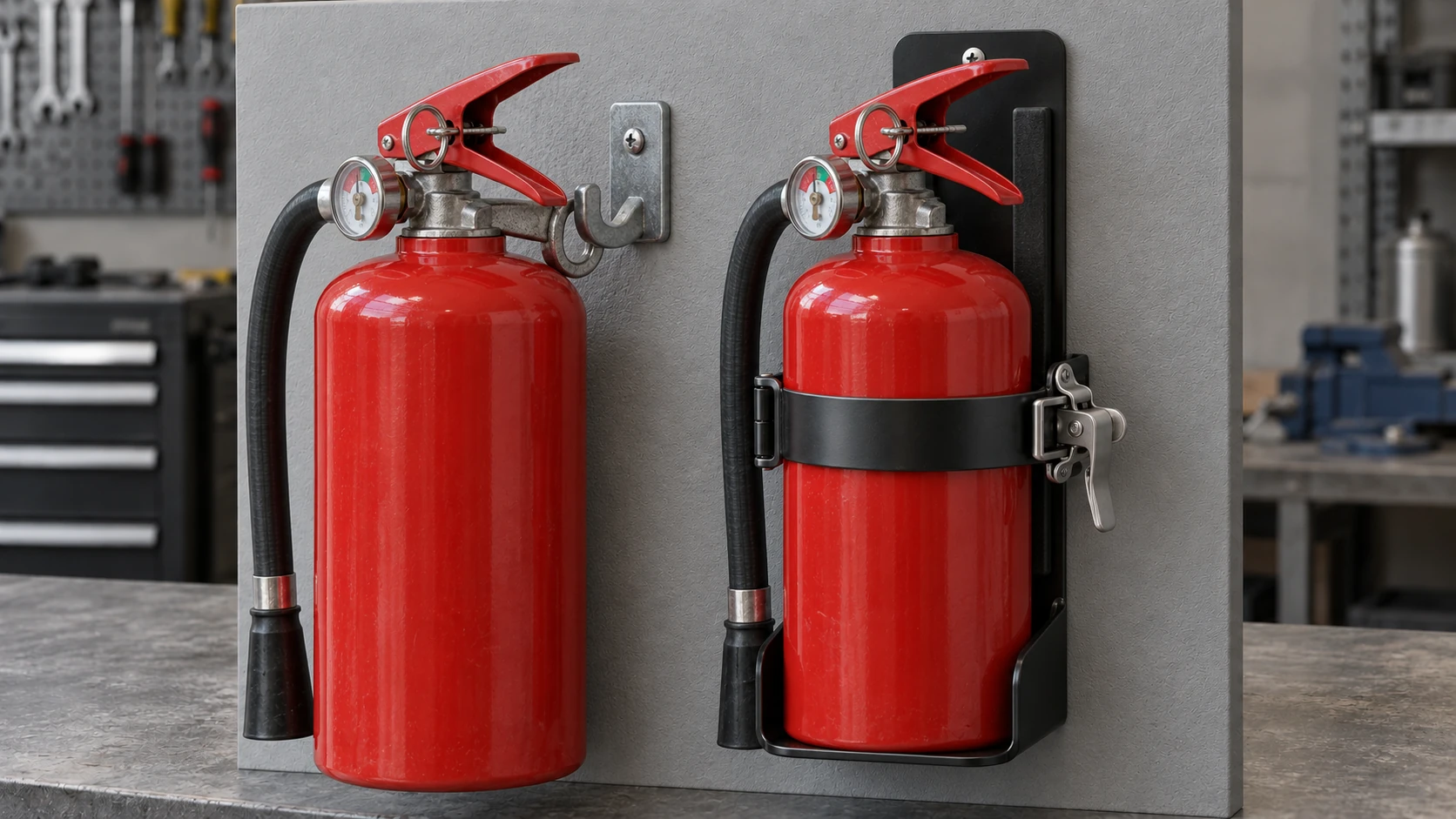
On a typical open wall hanger, the extinguisher’s hanging feature transfers its static weight to the hanger and attachment. Removal may involve lifting the unit free of that engagement. A retained design adds a strap, latch or other restraint that captures the intended part of the extinguisher and must be deliberately released before removal. “Positive retention” here describes that restraint-and-release function; it is not a shock or crash rating.
Braking, turning and road or equipment movement can load the assembly in directions other than downward. Upward or lateral displacement can challenge an engagement that principally supports downward weight. Review the intended orientation and restraint arrangement across the extinguisher contact points, bracket and attachment. This mechanical distinction does not predict the tested performance of a particular product.
The table describes functional examples, not exhaustive product classes. Wall-strap and multi-application designs also exist. Two straps, a heavier appearance or a “heavy duty” name does not establish greater strength or tested vehicle suitability.
Read the Application Designation Before Comparing Shapes
Amerex’s bracket reference separates wall-hanger, vehicle/marine/aviation and wall-strap designs, among others. Its bracket product description identifies the hardware as fitted to Amerex extinguishers. Those documents distinguish application and fit; their designations do not transfer to another manufacturer’s equipment.
Kidde’s 896698R retention strap bracket is described for home, boat and vehicle use, with fit tied to the Kidde models and product families listed on the page. It is a documented multi-application example. That description does not make every extinguisher of the same nominal capacity or fire rating compatible.
When reviewing fire extinguisher brackets, read the bracket part number, corresponding extinguisher model or series, application statement and mounting instructions together. A similar shape or product photo cannot establish cross-brand fit. If the documentation does not cover the proposed combination or location, obtain the manufacturer’s confirmation for that configuration before treating it as suitable.
Check the Exact Extinguisher and the Installed Release Path
Use the actual extinguisher configuration: charged gross weight, cylinder diameter and contact geometry, overall profile, hanging interface or base support, valve and handle layout, hose or horn position, and intended orientation. Nominal agent capacity describes the contents; it does not establish the complete unit’s weight or physical interfaces. Models with the same nominal capacity can differ at the points where a bracket supports or restrains them.
Check that the unit seats on the intended support points and that the strap or latch closes and engages as specified. Loose engagement, incomplete closure or interference with the valve or hose identifies a mismatch to resolve. Strap tension and fit tolerances must come from the manufacturer’s information for the combination, not from an assumed universal value.
Retention Must Be Releasable in the Actual Location
A latch accessible on a bench may be blocked by a door panel, adjacent equipment or trim after installation. Review the mount’s specified removal sequence: access to the latch, strap or release part; space for that part to move; and clearance to withdraw the extinguisher from its support. Check these spaces in the intended installed location, not only in a product thumbnail.
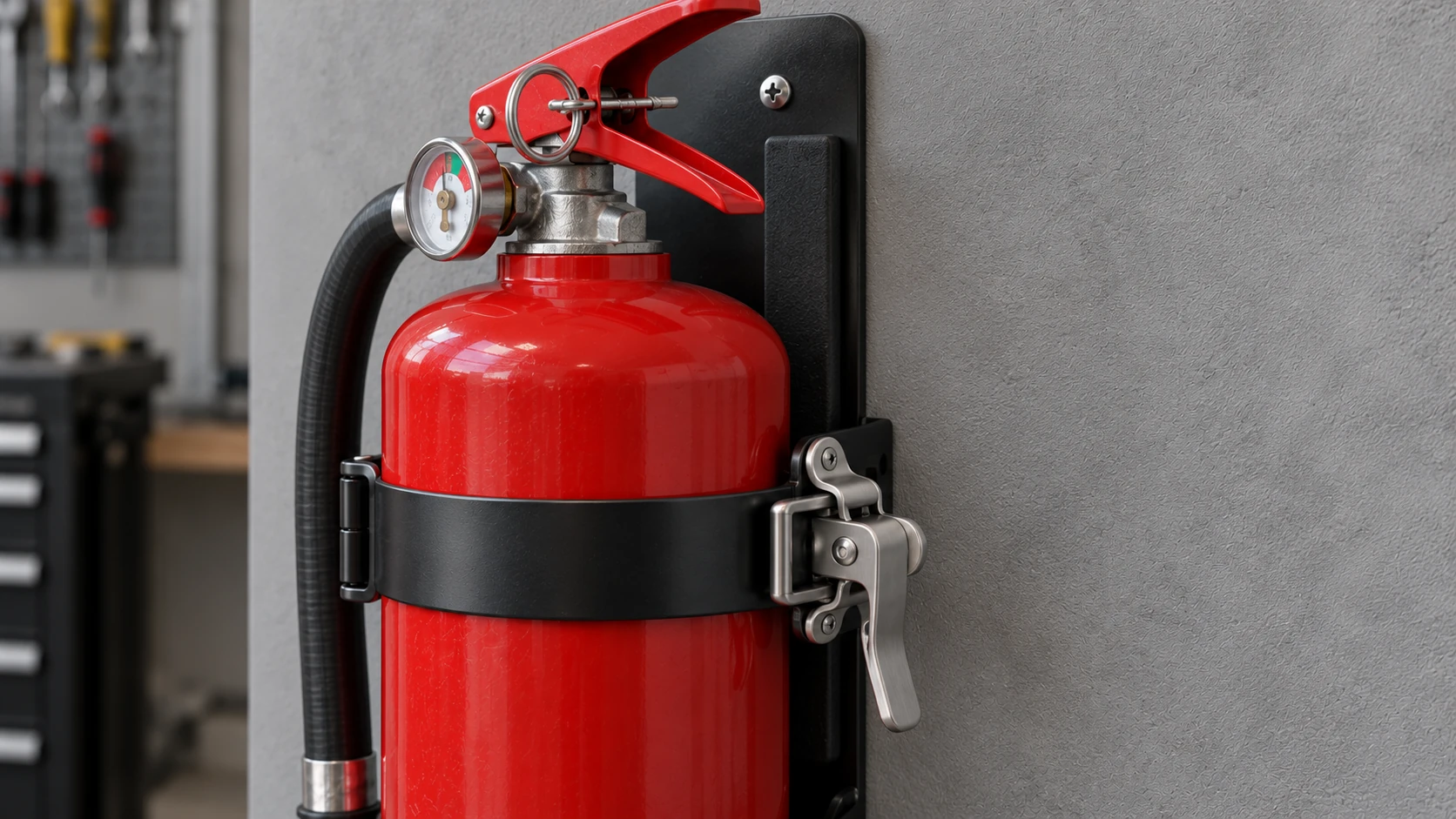
Identify which component each release instruction names. A mount may have its own release pin. The extinguisher’s operating safety pin is a separate component and must not be treated as the bracket’s release device. Neither a product name nor a photograph establishes one-handed or instant release for an unspecified assembly.
A Sample Fit Check Does Not Prove Dynamic Performance
A dimensioned drawing or sample fit check can help verify seating, closure, non-interference and removal access according to the instructions. A stationary fit check addresses geometry. It does not establish vibration endurance, impact resistance or crashworthiness.
If the project requires a tested performance claim, request the test report and identify the assembly, orientation and conditions it covers. A report that does not cover the proposed combination, or the number of straps on a bracket, cannot substitute for that evidence.
The Mounting Surface Completes the Assembly
The load passes from the extinguisher through the support and restraint to the bracket, fasteners and mounting structure. A closed latch does not establish the strength of a trim panel or unsupported surface. Coordinate the substrate, attachment layout and installed orientation with the manufacturer’s instructions and the vehicle or project requirements.
The Amerex hand-portable extinguisher manual distinguishes furnished mounting hardware from appropriate Amerex vehicle hardware, calls for attachment to a solid surface and provides substrate-specific mounting instructions. Its fastener details belong to those instructions; they are not a universal installation recipe. A hole-pattern drawing establishes attachment geometry, not a complete dynamic rating.
Specify the Assembly, Not Just the Capacity
A bracket request needs the equipment and installation details that define the combination:
- The extinguisher manufacturer, exact extinguisher model and supply configuration, charged gross weight and dimensioned profile.
- The bracket model or part number and its explicit intended fixed or mobile application.
- The cylinder, hanging or support geometry, closure arrangement and permitted orientation.
- The vehicle or project location, mounting surface and attachment arrangement.
- The available release and removal space, including nearby access constraints.
- Relevant environment or finish requirements and any documented performance or test requirement specified by the project.
Review fit and application again when the model, configuration, orientation or location changes. Poseidon can review dimensions and intended application for bracket or paired-supply requests.