

Unlike structural firefighting (interior attack in turnout gear) or daily duty at the fire station, wildland fire operations demand long hours on foot across steep, uneven terrain under extreme heat, smoke, and shifting weather. Firefighters may hike 12–16 hours per shift, so weight, breathability, and secure footing matter as much as protection.
Wildland firefighter boots are purpose-built for this mission: typically 8–10 in lace-up designs in leather uppers with minimal seams for durability and cooler wear. They forgo waterproof membranes to reduce steam-burn risk, use heat-rated Vibram fire boots with lug soles for traction in ash, rock, and duff, and rely on stitched-down or welted construction for stability and rebuildability. Most agencies specify compliance with NFPA 1977 safety standards and applicable ASTM F2413 protective toe criteria, delivering a balance of durability, mobility, and comfort that bunker boots can’t provide on the fireline. Understanding these boots starts with their definition, construction, and the standards they’re built to meet.
Wildland Fire Boots
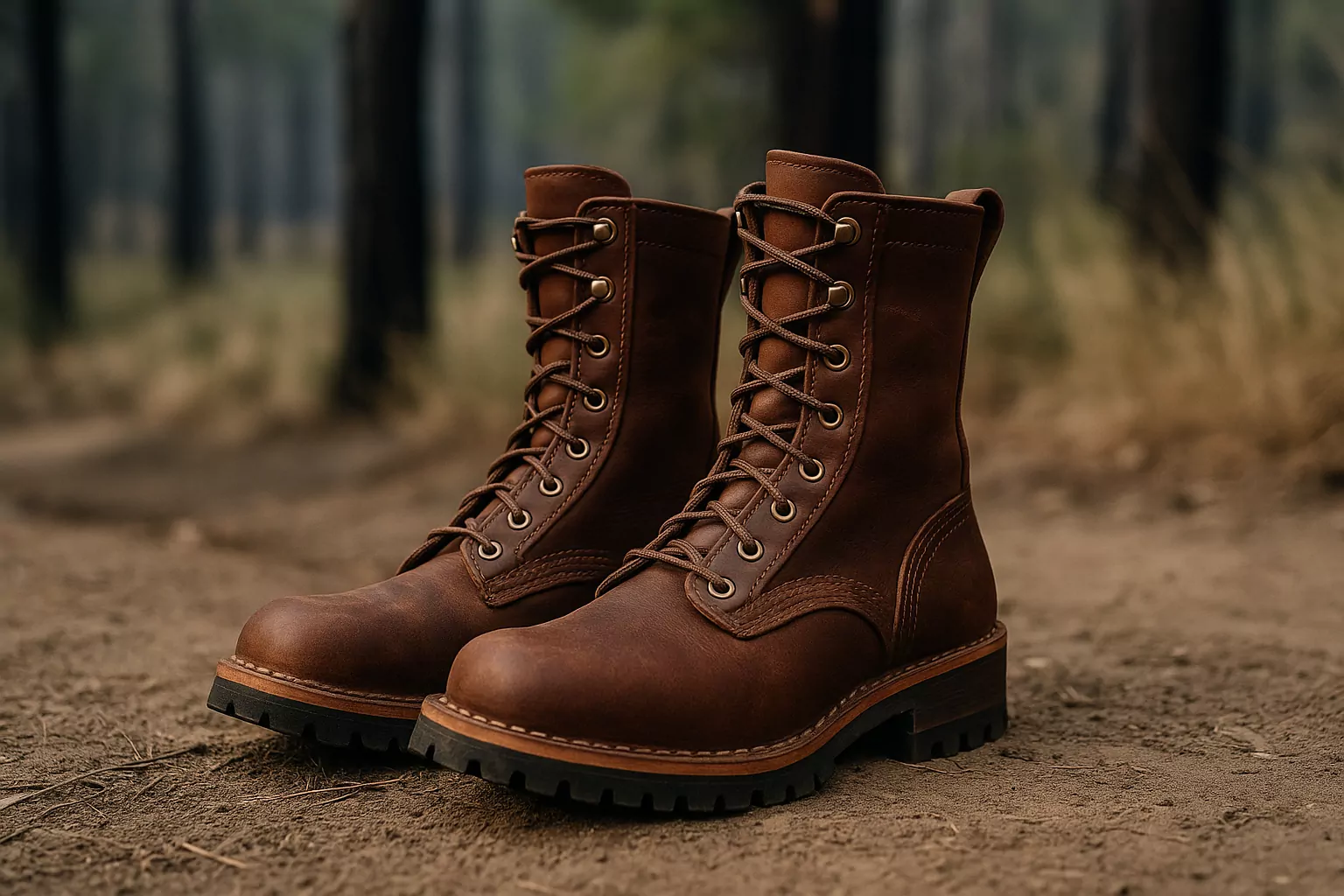
Wildland firefighter boots are a specialized class of fire boots built for extended operations on the fireline—long hikes, steep and uneven terrain, high ambient heat, ash and duff, and rapidly changing weather. Unlike structural firefighting boots (bunker boots), they prioritize mobility, breathability, and endurance rather than interior-attack thermal barriers.
Most wildland firefighter boots use an 8–10 in lace-up shaft for ankle support without restricting stride. Uppers are leather uppers (often 7–8 oz) with minimal seams for durability and cooler wear; waterproof membranes are avoided to reduce steam-burn risk. Common build methods are stitched-down or Goodyear welt construction that stabilize the platform and allow re-soling/rebuilds. Outsoles are heat-rated lug soles (e.g., Vibram-type compounds) with a defined heel breast for downhill braking; midsoles typically use leather or fiberboard with cork fill to manage weight, shape, and shock. Protective toes (steel or composite) and puncture-resistant plates are specified per policy.
Wildland boots are engineered to meet or exceed NFPA 1977 for wildland PPE and typically conform to ASTM F2413 for impact/compression (I/75, C/75) and, where required, EH electrical-hazard ratings (commonly validated to 18,000 V dry test conditions). Heat performance focuses on outsole/upper integrity under short-duration high-temperature contact; many agency specs and compound datasheets target ≈300 °C / 572 °F surface contact without delamination, softening, or dripping, and traction is verified on dusty, rocky, and ash-covered substrates. Fit and comfort features—secure heel lock, torsional support, and arch support—are emphasized to control fatigue over 12–16-hour shifts.
Best for wildland fire suppression, line construction, mop-up, patrol, and remote deployment roles (including smoke jumper and hand-crew work). They are not interchangeable with structural bunker boots: wildland models lack the moisture/thermal barrier systems required for interior structural firefighting and should not be used for IDLH interior attack.
Requirements for Wildland Fire Boots
Regulatory framework.
Wildland firefighter footwear is governed by NFPA 1977 (protective clothing and equipment for wildland fire). Many U.S. agencies (e.g., U.S. Forest Service, CAL FIRE, NWCG) mirror or reference this standard in their dress codes and procurement specs.
Core construction & dress-code essentials.
Height: Minimum 8 in lace-up shaft to stabilize the ankle and keep debris out; many crews prefer 10 in for added support on steep ground.
Upper material: Leather uppers (full-grain), with minimal seams and heat-tolerant thread/eyestays. Rubber or fully synthetic boots do not comply with NFPA 1977 footwear requirements.
No waterproof membrane: Eliminates trapped moisture and reduces steam-burn risk during long, high-heat hikes.
Outsole: Heat-rated lug sole (Vibram-type) with a defined heel breast for downhill braking; oil- and slip-resistant compounds suitable for dirt, ash, and rock.
Construction: Stitched-down or Goodyear welt platform for torsional stability, edge support, and resoling/rebuilds.
Optional protective elements (per agency policy): Steel toe or composite toe meeting ASTM F2413 impact/compression (I/75, C/75), puncture-resistant plates, and EH electrical-hazard ratings (commonly validated to 18 kV dry test conditions).
Performance metrics.
Heat integrity: Focus on outsole and upper integrity under short-duration, high-temperature contact typical of hot ash, rocks, and embers; agency specs and compound datasheets commonly target ≈300 °C / 572 °F surface contact without softening, dripping, or delamination.
Traction & stability: Lug geometry and heel design must maintain grip on loose duff, scree, and ash-covered rock while controlling descents under load.
Endurance & fit: Secure heel lock, torsional support, and arch support to limit fatigue during 12–16-hour operational periods; moisture-wicking linings and breathable leather manage heat and perspiration.
Operational limits.
Wildland fire boots are not interchangeable with structural bunker boots. They lack the moisture/thermal barrier systems required for interior structural firefighting and must not be used for IDLH interior attack.
Why Wildland Fire Boots Do Not Follow NFPA 1971 Standards
Different fire environments require different footwear standards. NFPA 1971 (formerly 1970) governs structural firefighting boots, which are designed for interior fire attack and exposure to flashover-level radiant heat. These boots incorporate heavy thermal barriers, waterproof membranes, and moisture liners that are critical for structure fires—but such construction makes them bulky, heavy, and poorly ventilated.
In contrast, wildland firefighting boots must support long-distance hiking, steep terrain, and prolonged exposure to moderate radiant heat rather than short bursts of extreme interior fire conditions. Wearing structural firefighting boots in wildland operations would dramatically increase the risk of heat stress, blisters, and steam burns due to trapped perspiration.
That is why NFPA developed a separate standard—NFPA 1977—to address the unique mobility, breathability, and durability needs of wildland firefighters. NFPA 1977-compliant boots feature leather uppers, stitched-down construction, heat-rated lug soles, and no waterproof membranes, ensuring comfort and function during 12–16-hour shifts in rugged outdoor environments.
Best Wildland Fire Boots
Wildland fire boots are not interchangeable—design philosophy drives fatigue, traction under load, and long-term foot health. Start by confirming the boot is NFPA 1977–certified for wildland firefighting footwear (edition and scope), then choose the platform that matches your crew role and expected service life.
Top Tier: Long-Term Investment (Wildland Specialists)
Nick’s Boots — BuilderPro / Hotshot: Built around true build-level customization, not a fixed SKU. Typical options include 8″–14″ boot height, multiple Vibram® lug outsole selections (e.g., fire-service lugs), edge finishing, stitch color, and a wide range of last widths and arch profiles. Uppers commonly use 7–8 oz full-grain leather and a rebuildable platform intended for multi-season line work under pack weight. Expect a longer break-in, but the payoff is sustained support and repeatable fit over years of service.
White’s Boots — Smokejumper: A heritage stitch-down platform commonly configured around 10″–12″ heights, chosen for predictable stability on steep terrain. The construction favors torsional control and load transfer when climbing, side-hilling, and working in uneven fuels, with rebuildability extending service life across multiple seasons. Break-in is longer by design because the boot prioritizes structural support over immediate softness.
JK Boots — Super Duty / Fire Inlander: Purpose-built wildland models offered in 8″–12″ heights, including durable bison leather options. These boots emphasize abrasion resistance and ankle support, with a break-in profile that is typically more forgiving than traditional smokejumper builds while preserving rebuildable longevity for career crews.
Excellent Alternatives: Lighter Weight, Faster Break-In (First-Season Friendly)
Danner — Flashpoint / Wildland Tactical: NFPA 1977-certified boots commonly issued for rapid onboarding. They use custom Vibram® Fire Lug outsoles and factory-set configurations (typically 8″–10″) to deliver consistent sizing, quicker break-in, and reduced weight for firefighters who cannot afford a long conditioning period.
Kenetrek — Wildland Fire Series: Fixed-configuration wildland boots built around supportive midsole geometry and aggressive traction. The design targets comfort under long hikes and mixed terrain without the stiffness of heavy rebuildable platforms, making them a practical choice for rotational crews and long-shift mobility.
HAIX — Missoula 2.1: NFPA 1977-certified wildland boot frequently produced in an 8″ height with a comfort-first fit and reduced fatigue profile. Cemented construction and fire-rated lug outsoles favor immediate wearability and reliable support for extended WUI or mixed-response days.
Scarpa — Fuego: A mountain-footwear-derived wildland boot with defined rocker geometry for walking efficiency and faster adaptation. It is commonly selected by first-season firefighters who prioritize mobility and comfort while still requiring certified protection.
Value-Focused Certified Options: Practical Compliant
Poseidon Fire Tech — Task-Specific NFPA-Compliant OEM Builds: OEM programs are structured around mission type: NFPA 1977 for wildland firefighting footwear, with separate designs and test plans used for station or structural-duty boots where applicable. This approach reduces compliance risk and inventory variance by keeping certification scope tied to the actual use case, while maintaining predictable sizing and procurement-focused cost control.
Firewest — Model 5051: A standardized NFPA 1977–certified option commonly issued for training rotations, reserve inventory, and volunteer departments that need compliant footwear without premium customization.
Rocky — Code Red Wildlands 77: NFPA 1977-certified boots with fixed configurations and accessible sizing, commonly issued by departments managing mixed-experience crews and reserve gear programs.
Key Selection Factors (2025)
Key considerations include boot height selection, outsole type, break-in time, rebuildability, and verified NFPA 1977 certification scope. Proper fit and structural support directly influence long-term foot health and operational endurance, particularly for firefighters spending multiple seasons on the line.
Wildland fire boots are more than just footwear—they are life-saving tools designed for the unique challenges of outdoor firefighting. Built to comply with NFPA 1977 standards, they combine durability, heat resistance, and mobility to keep firefighters safe and effective during long shifts on rugged terrain. Choosing the right pair means reducing fatigue, preventing injury, and ensuring firefighters can stay in the fight when it matters most.
At Poseidon, we specialize in designing and manufacturing wildland firefighter boots and offer tailored OEM services for departments and agencies worldwide. As a professional fire boot manufacturer, we understand the foot protection risks firefighters face in extreme environments. Contact our experts today to explore advanced solutions that enhance your safety, comfort, and operational performance.