

Unlike station boots, structural bunker boots are worn directly into structural firefighting, making them among the most common structural firefighting boots used in the U.S. fire service. Structural bunker boots should be evaluated against the applicable NFPA 1970 requirements and the certification or listing documentation for the exact model. Additional footwear standards or test methods can apply depending on the product design and procurement specification. Most feature a full-length 14–15-inch shaft that interfaces with bunker pants to seal out water and embers, along with fire-resistant rubber insulated or leather structural constructions, moisture barriers, puncture resistant plates, ladder shanks, and heat- and slip-resistant lug soles. A damaged fire boot or a foot injury during an incident can have the same operational impact as losing a crew member—reducing readiness and increasing operational risk—so recognized manufacturers engineer bunker boots to prevent those failures.
What Are Bunker Boots?
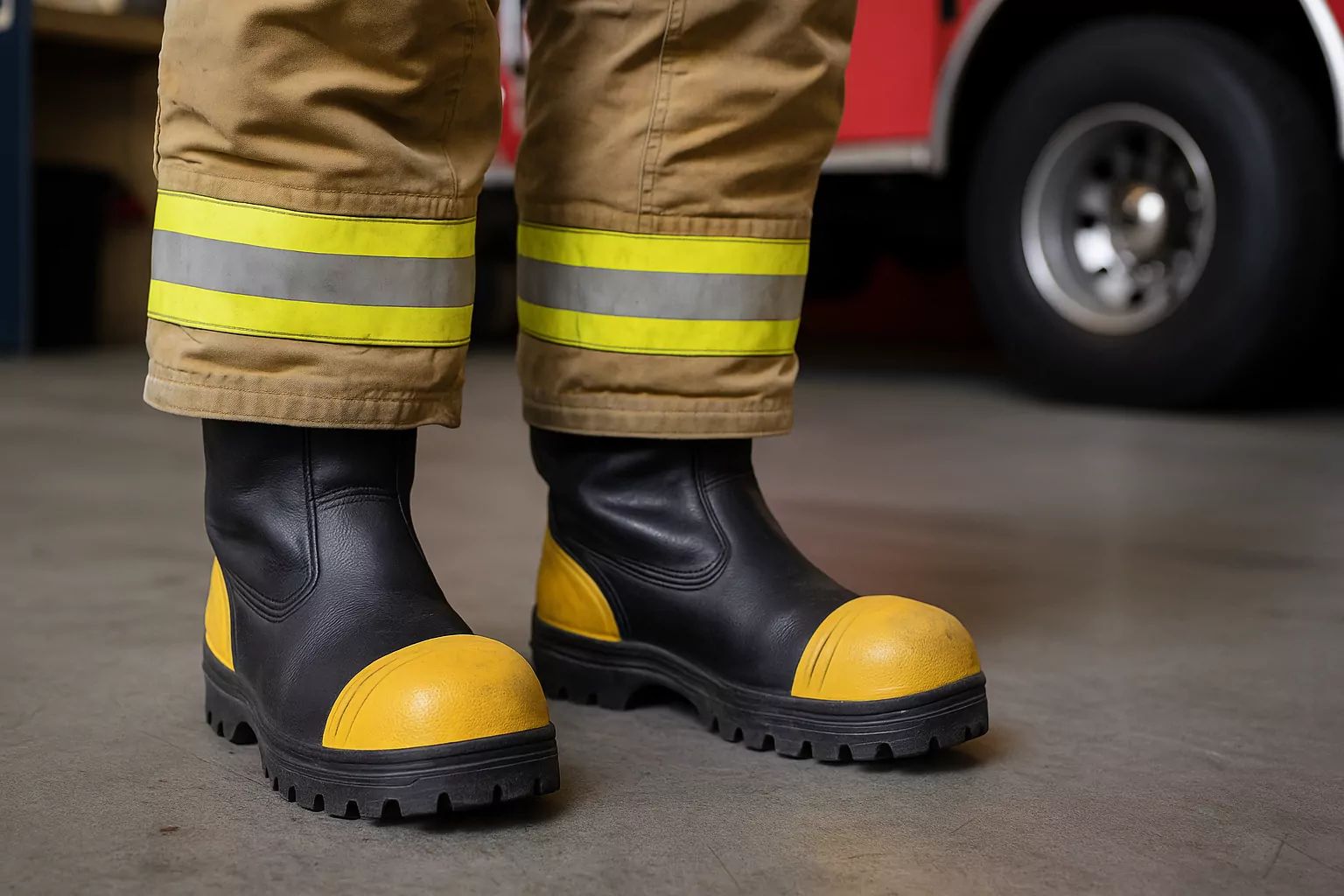
Bunker boots are structural firefighting boots purpose-built for interior attack, rescue, and other IDLH operations. The applicable NFPA 1970 requirements, additional test methods, and third-party certification or listing status should be verified against the exact bunker-boot model rather than assumed from the product category alone.
Most structural bunker boots use a full-length shaft around 14 inches to interface cleanly with bunker pants and seal out heat, water, and embers. Uppers are commonly rubber insulated (rubber boots) or leather structural, chosen for fire-resistant and chemical-resistant performance. Inside, a moisture barrier helps block liquids such as diesel fuel, hydraulic fluid, and battery acid. Underfoot, puncture resistant plates address hazards from sharp objects and debris, while ladder shanks provide rung stability. Outsoles are heat-rated boot with lug sole designs engineered for traction on wet, oily, or debris-covered surfaces and to retain structural integrity under sustained radiant heat exposure (≈500°F / 260°C for several minutes under typical NFPA heat-exposure protocols). Toe protects are provided by steel toe or composite caps. Many premium models also optimize fit and ankle support to maintain mobility without sacrificing protection.
Bunker boots are frontline fire boots for structural firefighting—environments with high radiant heat, collapse hazards, falling debris, and hazardous liquids. They are not intended to replace wildland or station boots, where endurance hiking or all-day duty comfort drive different design priorities.
Globe Supreme 14″ Structural Bunker Boot: leather structural upper, moisture barrier, ladder shank, heat-rated boot with lug sole, steel toe, and third-party certification—engineered to meet or exceed NFPA/ASTM criteria while maintaining fit and mobility.
Why They’re Called “Bunker Boots”
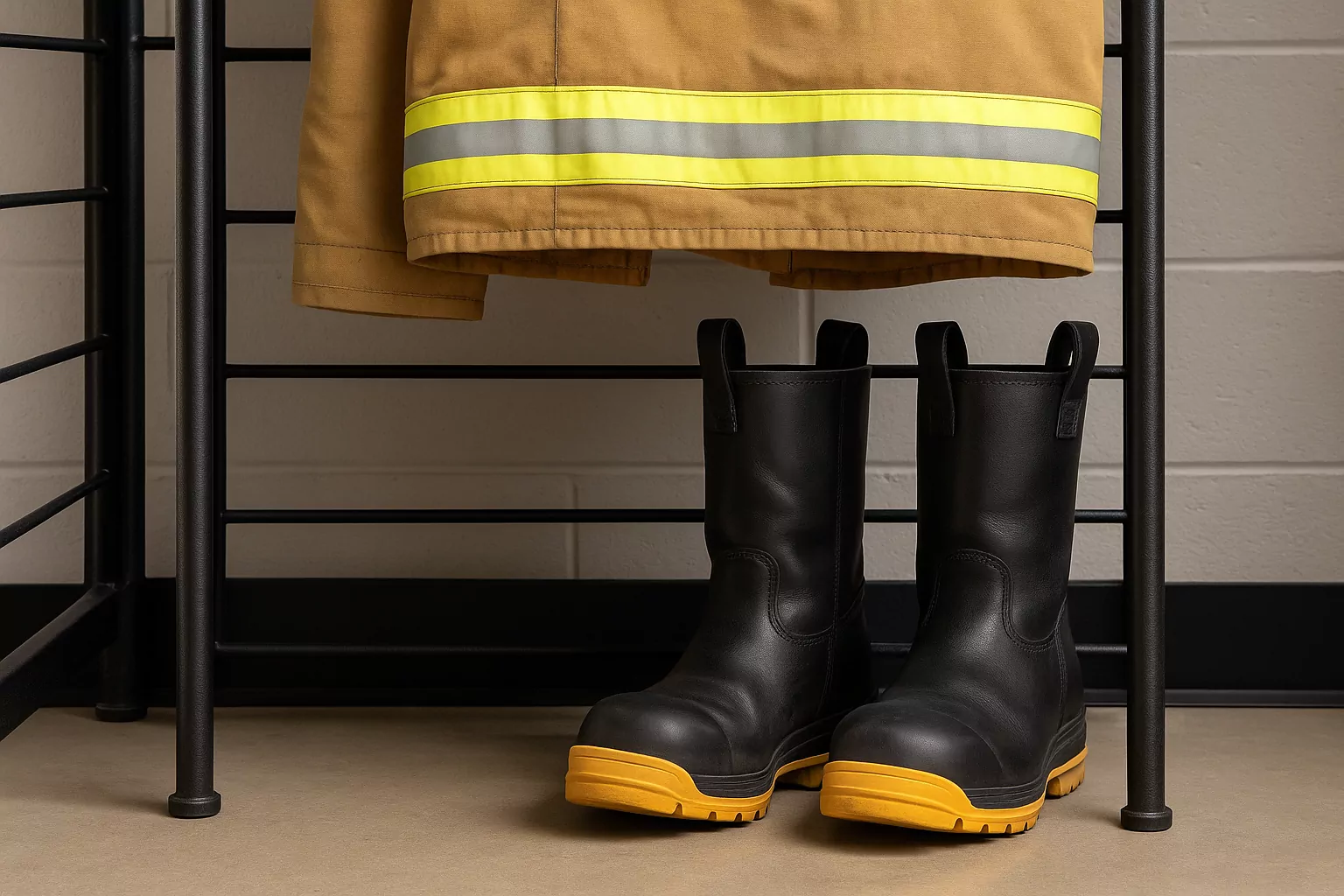
Early fire stations kept boots pre-positioned with turnout pants in the lower compartment—the “bunker” shelf—of a locker or gear rack. The pant cuffs were folded over the shafts so a firefighter could step into both pieces in one motion as the alarm hit, cutting turnout time and keeping the set ready on the apparatus bay floor.
Current selection, care, and maintenance requirements for structural and proximity firefighting PPE are addressed within NFPA 1850. Departments should follow the applicable current standard, manufacturer instructions, and their own contamination-control procedures when cleaning, transporting, storing, or returning used boots and turnout gear to service.
Despite the storage changes, the name “bunker boots” stuck and remains the dominant U.S. term for structural firefighting boots. You’ll also see “turnout boots” or “structural bunker boots.” In some locales they’re informally called “combat boots,” but that label can be confused with military footwear, so technical documents typically avoid it.
Materials and Construction of Bunker Boots
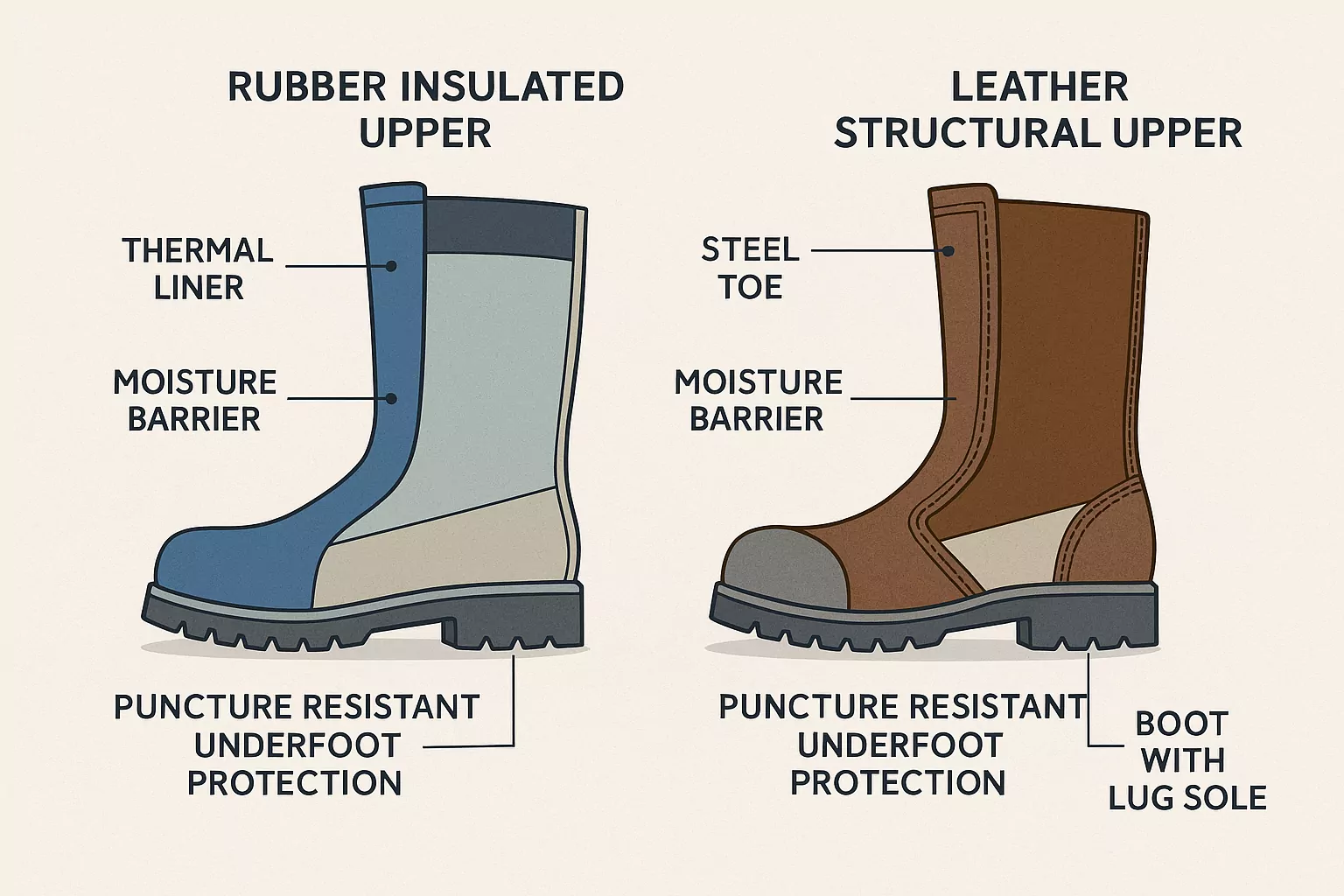
Upper constructions — rubber insulated and leather structural.
Structural firefighting boots are built in two dominant upper systems. Rubber insulated models use vulcanized natural/synthetic rubber shells with reinforcement scrims; they’re inherently waterproof, fuel/chemical tolerant, cold-flexible, and typically paired with a thermal liner for insulation and comfort. Leather structural models use full-grain, flame-resistant leather with hydrophobic finishes; they offer cut resistance, better MVTR-driven breathability, and ergonomic ankle flex for mobility. Both constructions are certified as elements of the structural ensemble under NFPA 1970.
Underfoot Protection and Load Management
Underfoot protection in bunker boots relies on a multi-layer composite sole system, not a single puncture plate. The outsole, typically made from high-performance nitrile rubber or specialty compounds (such as heat-resistant fire-service formulations), is engineered to withstand direct contact temperatures approaching 300 °C (572 °F) while resisting oils, fuels, and fireground chemicals.
Above the outsole, a dual-density midsole—often rubber, PU, EVA, or hybrid foam—absorbs impact, reduces fatigue, and acts as a thermal barrier against conductive heat from debris and hot surfaces.
Puncture protection is provided by steel or high-strength textile layers. Steel plates deliver maximum penetration resistance, while aramid or composite fabrics are used where NFPA electrical insulation requirements (up to 12,000 V) must be maintained. A rigid shank or support plate (steel or composite) stabilizes the arch, limits excessive sole flex on ladders and stairs, and improves load transfer during interior operations.
Outsoles & heat/slip performance.
Heat-rated boot with lug sole designs are compounded from nitrile/high-temp rubbers to maintain traction on wet/oily/debris surfaces and to tolerate sustained radiant/convective heat exposures required in NFPA footwear testing. Many premium models use Vibram Fire & Ice compounds that maintain flexibility and traction from roughly −20 °C to +250 °C and satisfy NFPA flame-resistance needs—useful for cold-weather incidents with hot surfaces.
Structural supports & ladders.
Ladder shanks or full-length boards add midfoot rigidity and rung stability without over-stiffening the forefoot, preserving climb control under load; these elements are conditioned and evaluated alongside other components during NFPA heat/conditioning sequences.
Manufacturing processes & QC.
Rubber boots are built by lay-up and vulcanization (press cure) for wall-thickness uniformity and shell bonding; leather structural boots are lasted, stitched (cemented, welted, or stitch-down), and sealed at stress points. Production lots undergo dimensional checks plus destructive tests (e.g., outsole adhesion, tear/tensile, puncture) before certification release; departments should verify SEI-listed compliance and the applicable NFPA 1970 edition for procurement.
What NFPA/ASTM tests mean in practice.
For footwear elements, NFPA 1970 specifies heat/thermal conditioning (e.g., convective and radiant heat conditioning prior to performance tests), flame exposure, slip resistance on prescribed surfaces, liquid integrity, and other hazards; these regimes ensure boots meet or exceed the ensemble’s thermal and mechanical thresholds in structural firefighting boots. ASTM F2413 covers the toe impact/compression and related classifications used across models.
Bunker Boots vs. Station Boots & Wildland Fire Boots
Bunker Boots – Designed for structural firefighting, with tall shafts (≈14″), rubber insulated or leather structural construction, boot with lug sole, steel toe, and full thermal, puncture, and chemical protection to meet or exceed NFPA 1970. Built to handle interior attack, flashover-level heat, and debris-heavy environments.
Station Boots – Worn for daily station duties and non-emergency tasks. Shorter height (6–8″), lighter weight, often leather with comfort-oriented soles. Not rated for structural firefighting heat or chemical hazards; typically meets basic ASTM impact/slip standards only.
Wildland Fire Boots – Purpose-built for prolonged outdoor wildfire and urban-interface operations. Their protection, construction, fit, and model documentation should be evaluated against the applicable NFPA 1950 requirements rather than structural-firefighting footwear requirements.
In short: Bunker Boots are heavy-duty, heat-and-impact armor for burning structures; Station Boots are comfort-focused work footwear; Wildland Fire Boots are endurance gear for long, hot, outdoor firefights.
Bunker boots are essential structural firefighting boots engineered to protect against extreme heat, hazardous materials, and mechanical threats, combining specialized materials, rigorous construction, and compliance with NFPA standards.
At Poseidon, we provide a full range of bunker boot solutions—rubber insulated, leather structural, and advanced hybrid models—tailored to meet your operational needs. Contact our experts today to upgrade your fireground protection and performance.