

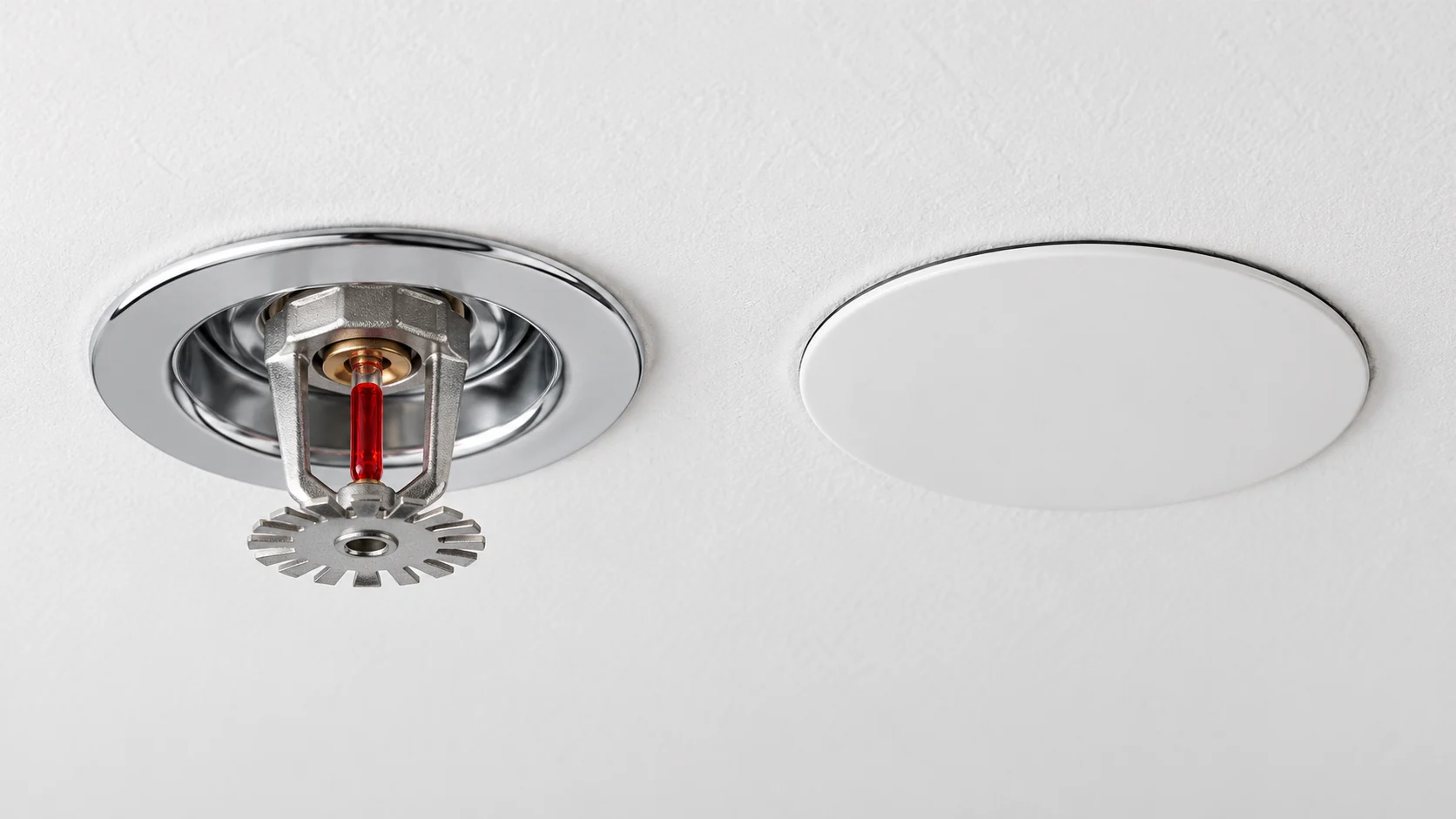
A recessed pendent sprinkler sits partly above the finished ceiling, but its frame, thermal element, and deflector remain visible within an escutcheon. A concealed sprinkler hides behind a cover plate. That plate is a heat-releasing part of its assembly; water flow still depends on the sprinkler’s own operating element. The choice combines the appearance you want with the configuration the system and ceiling can accept.
Compare what is visible and what each part does
| Comparison | Recessed sprinkler | Concealed sprinkler |
|---|---|---|
| Finished appearance | The escutcheon surrounds the ceiling opening; the sprinkler’s working parts remain visible. | The cover plate hides the sprinkler assembly. Its face and edge are visible from the room. |
| Outer part’s job | The escutcheon finishes the opening and forms part of the specified recessed installation. | The cover belongs to a specified assembly and releases under heat to expose the sprinkler. |
| Thermal operation | The sprinkler’s operating element responds to heat and releases the waterway closure. | The cover releases first. The sprinkler’s operating element must then operate before water flows. |
| Component matching | Use the escutcheon specified for the sprinkler and installation. | Match the sprinkler with its specified cover assembly, temperature rating, and finish. |
| Ceiling fit | Recess and adjustment limits depend on the sprinkler and escutcheon combination. | The assembly’s depth, cover seating, adjustment, and required edge gap depend on the model. |
| Finish | Select a finish permitted for the specified sprinkler and trim. | Select an approved factory finish. Field paint or coating can interfere with the cover’s function. |
| Response and coverage | Read the model’s response classification and coverage requirements. | Read the same fields. A concealed appearance does not establish a response classification. |
“Pendent” describes the sprinkler’s installation orientation. “Recessed” and “concealed” describe the configuration around it. Orientation, response classification, coverage, and the listed installation conditions are separate fields to check when comparing products.
A concealed cover releases before the sprinkler opens
A cover lying on the floor does not, by itself, prove that water has flowed. Its release exposes the sprinkler to heat; the sprinkler still has its own thermal operating element holding the waterway closed.
Glass-bulb concealed sprinkler operation
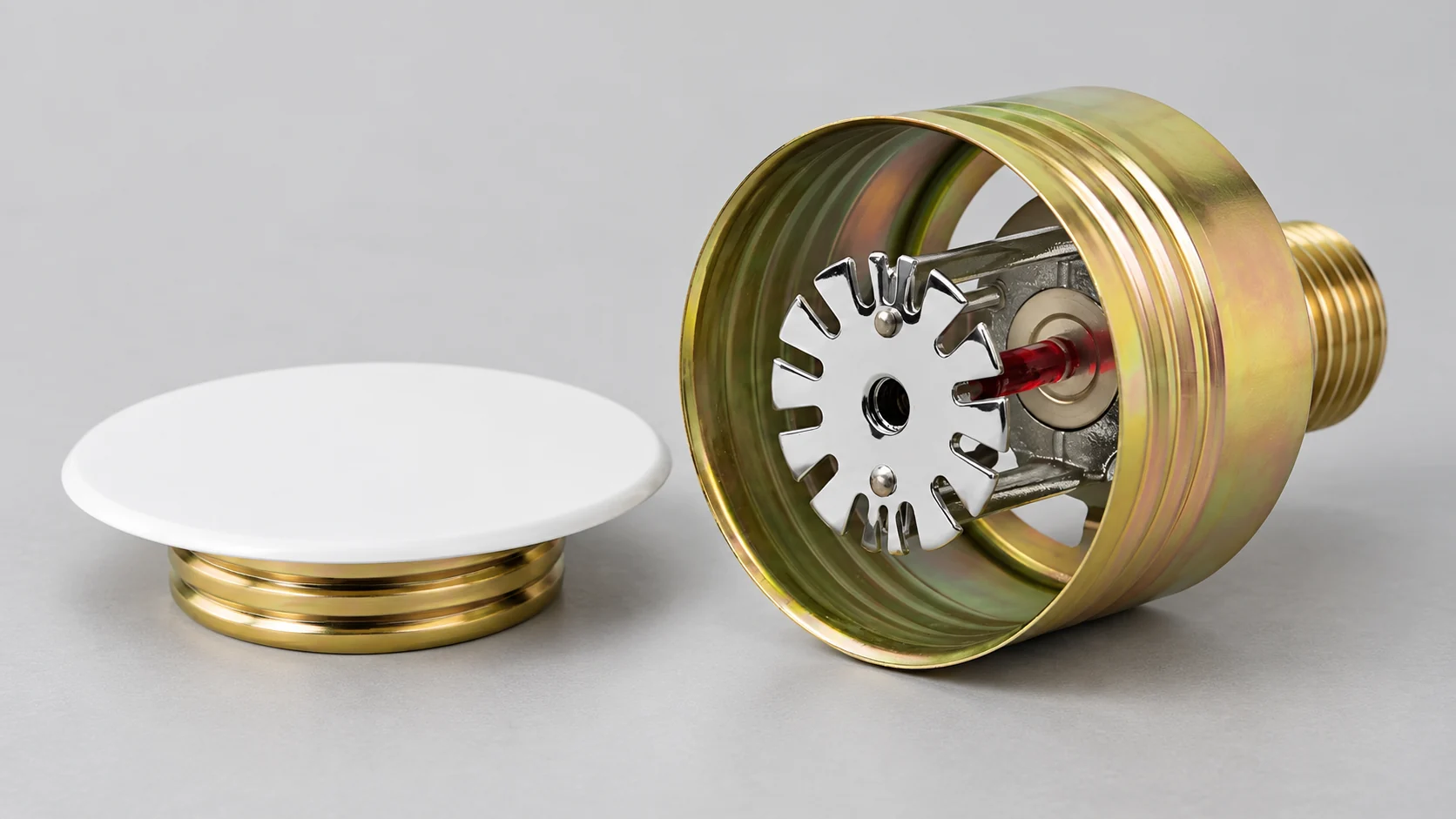
A glass-bulb concealed sprinkler assembly pairs a 139°F (59°C) cover with a 155°F (68°C) sprinkler. Heat releases the soldered cover. The deflector, supported by guide pins, then drops into its operating position. Heat also expands the fluid inside the glass bulb; when the bulb shatters, the sprinkler opens and water can flow. The cover and sprinkler have separate temperature ratings and respond to the heat reaching each component.
Concealed sidewall designs can use a fusible solder link instead of a glass bulb. The operating element and deflector arrangement depend on the assembly.
Match the assembly, ceiling position, and finish
Two white covers with the same diameter can belong to different assemblies. Identify the sprinkler model, then find the component the manufacturer specifies for that configuration. A sprinkler identification number (SIN) helps locate the product documentation; the replacement still needs the specified cover assembly and rating. Recessed trim also needs to match the approved sprinkler-and-escutcheon combination.
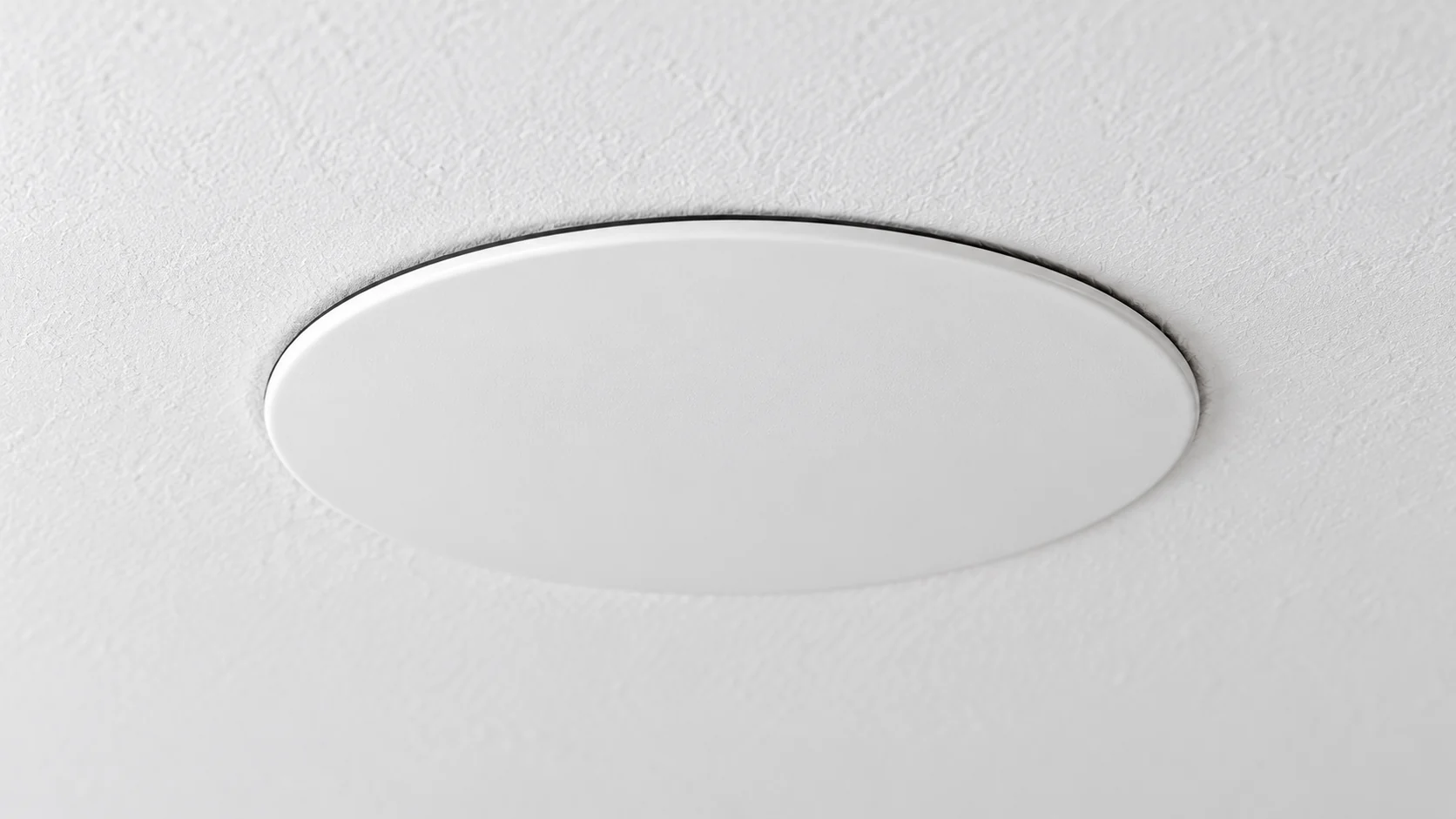
The finished ceiling must fall within the assembly’s permitted installation and adjustment range. A concealed cover designed with an edge air gap needs that gap to remain open for proper operation. Paint or caulk must not close it. Have a qualified sprinkler contractor check a mismatch rather than using loose or overtightened sprinkler threads to compensate for ceiling height.
Specify the permitted factory finish when ordering. Matching colors do not establish component compatibility. Use the permitted factory finish instead of painting an installed cover.
Make the decision for a new project or an existing sprinkler
A new finished ceiling
Choose recessed if the design calls for visible working parts surrounded by trim; choose concealed if it calls for a cover face hiding the assembly. Then have the sprinkler designer match the required orientation, response, coverage, and listed configuration to the ceiling’s construction and finished position. Appearance alone cannot establish which model fits the system. When comparing fire sprinkler heads, keep those design fields alongside the ceiling detail.
A missing cover or a change of appearance
For a missing concealed cover, have qualified sprinkler personnel identify the installed sprinkler and obtain its specified replacement assembly. A missing plate is not a reason to leave the sprinkler uncovered, even if it has not discharged. For an existing recessed sprinkler that you want to hide, a decorative disc placed over it cannot establish an approved concealed configuration. A qualified designer or contractor must check whether the change requires another sprinkler, assembly, or installation position.
For a new selection or a replacement inquiry about concealed fire sprinkler heads, provide the existing model identification or project design requirements, desired appearance, finished-ceiling position, required response and coverage, and specified component, temperature rating, and factory finish.