

In the fire service, firefighting boots are designed as life-safety PPE, not accessories. When a sole fails—through exposure to heat and flames, chemicals, adhesive breakdown, or flex fatigue—operational capacity drops immediately. Because National Fire Protection (NFPA) standards such as NFPA 1971 for structural firefighting boots and NFPA 1977 for wildland firefighting boots are performance-based rather than construction-prescriptive, the way a boot is built—how the upper, midsole, and outsole are joined—often determines whether it will keep performing after long hours of radiant heat, water, and ladder work.
This guide explains the major types of firefighter boots used today—Goodyear welt, stitched-down, cemented/direct-attach, injection-molded (DMS), and vulcanized rubber—and why they differ in durability, rebuildability, resistance to sharp objects, protection against heat resistant hazards, weight, and donning performance. Understanding these construction types helps departments and buyers select high quality firefighting boot options that balance safety toes (steel or composite), comfort, and safety standards compliance for structural operations, wildland fire suppression, and even station boots or general work boots.
Construction Types of Firefighter Boots
In U.S. fire service procurement, construction is as critical as the spec sheet. National Fire Protection (NFPA) footwear requirements (e.g., NFPA 1971 for structural firefighting boots and NFPA 1977 for wildland firefighting boots) are performance-based, not prescriptive—so how a firefighting boot is designed (upper–midsole–outsole joining method) largely determines durability, liquid integrity, chemical/thermal resilience, rebuildability, and comfort over long hours of duty.
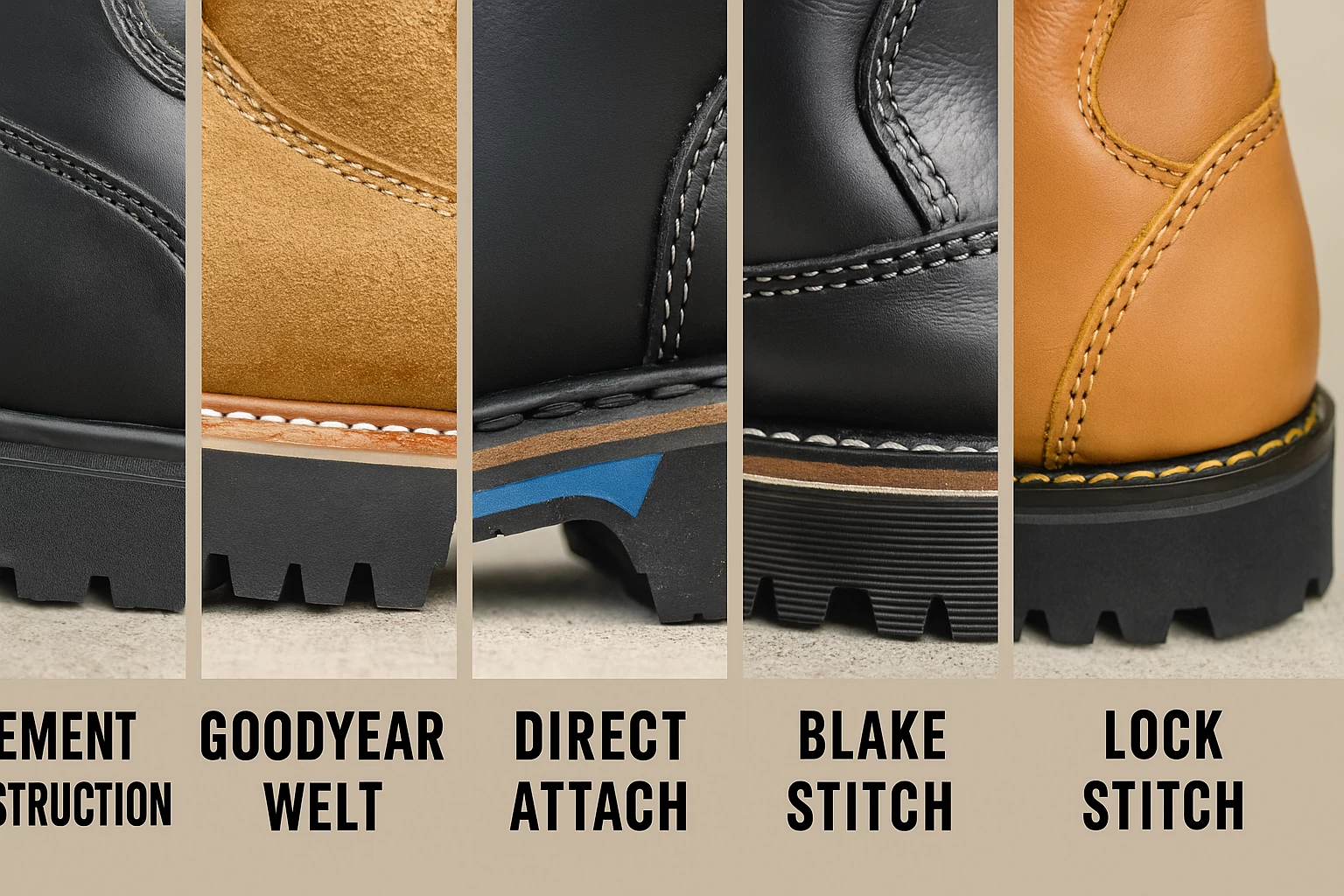
The main types of firefighter boots and when to choose them
1) Goodyear Welt (welted)
What it is: Upper stitched to a welt; welt stitched to midsole/outsole.
Why it matters: Highly durable, re-sole/rebuild capable, strong torsional support and ladder feel.
Trade-offs: Heavier; requires sealed stitching for liquid integrity.
Best for: Premium leather boots in structural or station boots where longevity and serviceability are priorities.
2) Stitched-Down
What it is: Upper flanged outward and stitched directly to the sole platform.
Why it matters: Broad, stable platform; good forefoot flex; breathable; often rebuildable.
Trade-offs: Liquid integrity depends on sealing; not ideal for heavy interior water/foam exposure.
Best for: Wildland firefighting boots focused on miles on foot and exposure to heat and flames, not interior attack.
3) Cemented / Direct-Attach (adhesive-bonded)
What it is: Outsole bonded to upper with high-temp adhesives.
Why it matters: Lighter, more flexible, faster break-in; good comfort.
Trade-offs: Adhesive can degrade with sustained heat or hydrocarbons; limited rebuildability.
Best for: Station boots and certain work boots where agility and weight matter more than maximum rebuildability.
4) Injection-Molded (Direct Molded Sole, DMS)
What it is: Molten PU or rubber molded around the upper to form a one-piece bond.
Why it matters: Excellent liquid integrity and bond strength; consistent factory sealing.
Trade-offs: Typically heavier; resoling uncommon.
Best for: Water/foam-intensive fire boots, decon-heavy environments.
5) Vulcanized Rubber
What it is: Components cured under heat/pressure into a seamless unit.
Why it matters: Outstanding chemical/steam resistance, cut/abrasion protection against sharp objects, and easy decon.
Trade-offs: Bulkier, warmer, less breathable/adjustable than lace-based high quality leather boots.
Best for: Industrial/chemical brigades and departments prioritizing maximum durability in structural firefighting boots.
What construction changes in real performance (quick specs to verify)
Puncture resistant midsoles: Must meet ASTM F2413 ≥ 1200 N (≈270 lb).
Slip traction: Require outsole validated under safety standards like ASTM F2913 on wet/oily surfaces.
Heat contact: Outsoles should tolerate heat and flames (250–300 °C / 482–572 °F) without delamination.
Safety toes: Verify steel or composite toe caps pass ASTM impact/compression.
Serviceability: Welted/stitched-down = rebuildable; cemented/DMS/vulcanized = non-rebuildable (budget accordingly).
Procurement notes (match construction to mission)
Structural firefighting boots (interior): Favor DMS or vulcanized for liquid integrity and heat resistant outsole performance.
Longevity / rebuild programs: Choose Goodyear welt or stitched-down fire boots.
Wildland operations: Lighter, breathable wildland firefighting boots with stitched-down builds.
Station duty / daily wear: Cemented station boots or work boots for comfort and flexibility.
Advantages and Disadvantages
Construction determines how a firefighting boot holds up to water, heat and flames, debris, and long hours on the fireground. NFPA footwear standards are performance-based, so procurement should match construction to mission profile, durability needs, and decon requirements.
| Construction Type | Durability (Rebuildability) | Liquid Integrity | Weight | Key Specs / Notes | Common Applications |
|---|---|---|---|---|---|
| Goodyear Welt (Welted) | Excellent; resolable/rebuildable; typical service life 5–7+ yrs with care | Moderate; needs sealed stitching/edges | Heavy | Stable platform; strong ladder feel; accepts puncture-resistant midsole (ASTM F2413 ≥ 1200 N/≈270 lb); outsole contact targets 250–300 °C (482–572 °F) | Premium leather boots; longevity programs; some structural firefighting boots and station boots |
| Cement (Adhesive-Bonded / Direct-Attach) | Moderate; limited rebuildability; adhesive can degrade with repeated high heat/hydrocarbon exposure | Moderate (good short-term; long-term depends on bond) | Light | Fast break-in; agile; verify compound/adhesive conditioning for heat and solvents | Station boots, some wildland and light rescue, tactical work boots |
| Direct Injection (DMS) | High; bond resists delamination | High; outsole molded to upper for one-piece seal | Medium | Consistent factory sealing; heat-rated lugs; typically non-resole | Structural firefighting boots, multi-purpose rescue; decon-heavy interiors |
| Strobel Stitch (In-Sock/Board) | Moderate; lighter structure, less torsional rigidity | Limited (requires added barriers for water) | Light | Flexible/athletic feel; comfort-focused; not ideal for heavy interior water/foam | Station boots, lightweight rescue/tactical |
| Molded / Vulcanized Rubber | Exceptional; unit-molded shell, very cut/abrasion resistant | Exceptional; 100% waterproof; easy decon | Heavy | Seamless shell; excellent chemical/steam resistance; less breathable/adjustable | Classic rubber fire boots, industrial/HAZMAT, wet/chemical interiors |
Slip resistance: For all constructions, specify outsoles validated per ASTM F2913 on wet/oily metal/tile.
Toe protection: Choose safety toes (steel or composite) that meet ASTM F2413 I/75, C/75.
Boot construction is the single biggest driver of a firefighter boot’s field performance—governing durability, liquid integrity, serviceability, traction, and comfort under heat and flames. From Goodyear-welt leather boots that can be rebuilt to vulcanized rubber fire boots that excel at decon and chemical resistance—and through stitched-down, cemented, and direct-injection builds—each method reflects specific engineering trade-offs in weight, heat/chemical resistance, and life-cycle cost. Selecting the construction that matches your mission improves compliance, readiness, and total cost of ownership.
Poseidon offers a full portfolio—welted structural firefighting boots, stitched-down wildland firefighting boots, direct-injection structural models, vulcanized rubber fire boots, and comfortable station boots—with safety toes (steel or composite), puncture-resistant options, and ASTM slip-tested outsoles. Our products are designed to meet or exceed NFPA 1971/1977 and supported with care guidance aligned to NFPA 1851. Contact our specialists for a spec review, fit-testing plan, and bid-ready technical language tailored to your department.