

Home » FM200 Fire Suppression System
FM-200 Fire Suppression System
Poseidon’s FM-200 Fire Suppression System uses HFC-227ea as a halocarbon clean agent for engineered gaseous fire suppression.
HFC-227ea is electrically non-conductive and leaves no extinguishing-agent residue after discharge. System design must account for the protected volume, hazard, enclosure conditions, agent concentration, storage cylinders, piping, nozzles, detection, release controls, and personnel-safety requirements.
HFC-227ea has zero ozone-depletion potential. It also has significant global-warming impact, so environmental and regulatory requirements in the destination market should be considered when specifying the agent.
The applicable design concentration and personnel-exposure limits depend on the engineered system and the requirements used for the project.
The current product pressure range is 1.2 MPa to 4.2 MPa (174 psi to 609 psi).
Available configurations include cabinet-mounted, external-storage, piped-network, and suspended arrangements.
The appropriate configuration depends on the protected enclosure, required agent quantity, cylinder arrangement, piping, installation space, and the limits documented for the selected system.
FM-200 Fire Suppression System Specifications & Configurations
FM-200 uses HFC-227ea, an electrically non-conductive clean agent that leaves no extinguishing-agent residue after discharge. This property makes clean agent fire suppression systems using HFC-227ea suitable for consideration in enclosed areas containing electrical or electronic equipment, subject to the complete system design.
FM-200 systems are designed to discharge the required agent quantity within the time specified by the applicable system design requirements.
System performance depends on the design concentration, enclosure integrity, agent quantity, pipe network, nozzle arrangement, detection, and release sequence. A residue-free discharge reduces agent cleanup, but it does not by itself establish equipment condition or downtime after a fire.
Information for an FM-200 System Enquiry
For configuration review or OEM supply, provide the protected-zone dimensions and net volume, hazard or fuel, minimum and maximum enclosure temperatures, occupancy, enclosure openings and leakage-control arrangements, and available cylinder locations. Include pipe routes and nozzle constraints, detection and release requirements, electrical supply, destination market, required system approvals, and order quantity. These inputs allow the agent charge, storage arrangement, discharge design, and quotation to be matched to the project.
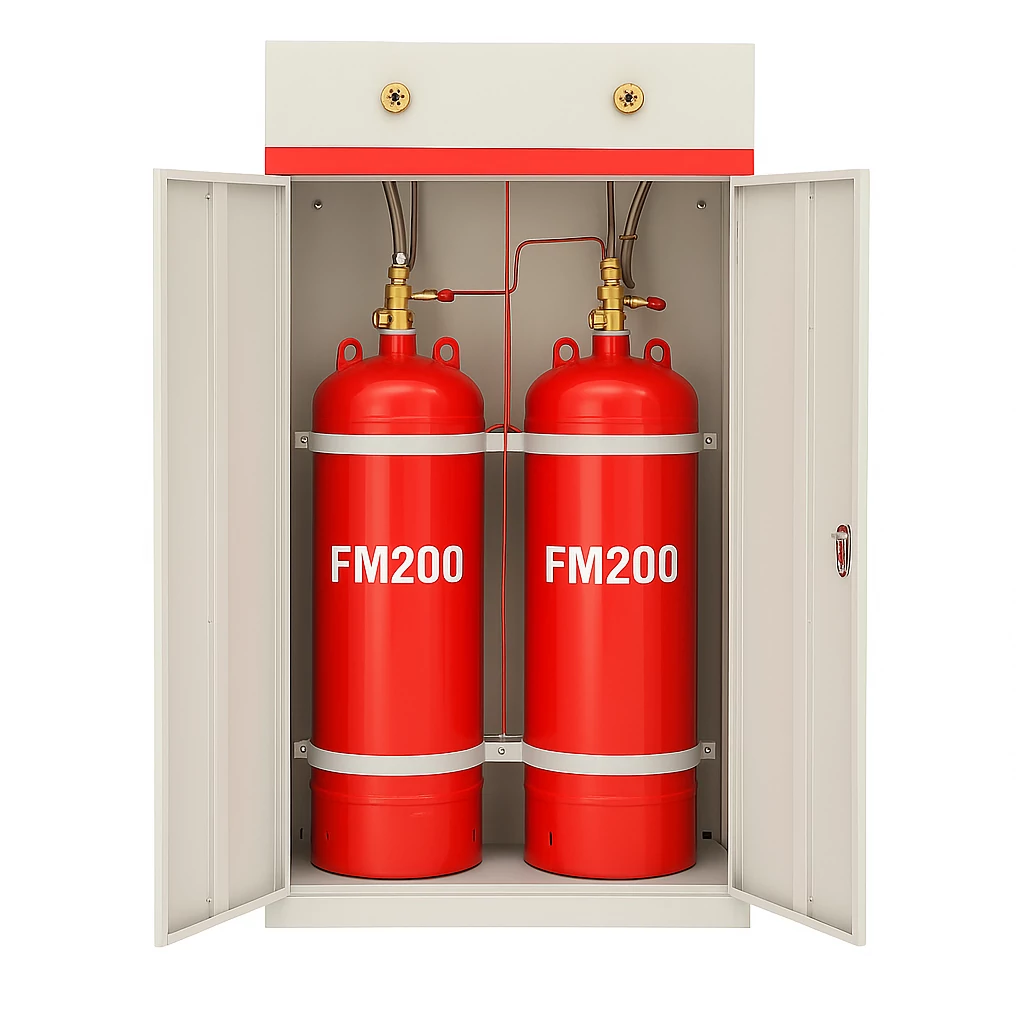
Single-Cabinet Configuration
Configuration: Cabinet-mounted storage for a single protected enclosure with space for the cylinder, release equipment, and service access.
Listed Cylinder Volume: 90 L (23.8 US gal).
Selection Inputs: Provide the net protected volume, hazard, enclosure temperature, cabinet location, and available discharge arrangement. The required agent charge and protected volume are determined by the complete design; cylinder water capacity alone does not establish room coverage.
Dual-Cabinet Configuration
Configuration: A dual-cabinet arrangement for projects requiring more than one storage cabinet, subject to the selected cylinder and release design.
Listed Cylinder Option: 120 L (31.7 US gal).
Selection Inputs: Specify the number of cylinders, agent charge per cylinder, cabinet positions, protected enclosure, and release arrangement. Confirm whether the quotation describes an individual cylinder or the complete cylinder bank; the listed volume is not a protected-room capacity.
External Storage Configuration
Configuration: Agent storage outside the protected enclosure, with the discharge route designed to serve that enclosure.
Listed Cylinder Volume: 150 L (39.6 US gal).
Selection Inputs: Provide the storage location, pipe route, elevation changes, protected enclosure dimensions, and nozzle arrangement. Available space, hydraulic calculations, enclosure integrity, and the required agent quantity determine whether remote storage is suitable.
Piped Network Configuration
Configuration: A piped network connects the storage arrangement and discharge nozzles. A multi-zone project requires an engineered release and agent-distribution arrangement for the defined protected zones.
Listed Cylinder Options: 90 L to 150 L.
Selection Inputs: Supply the zone schedule, enclosure volumes, pipe routes, fittings, elevation changes, and nozzle locations. Specify the required release sequence and whether more than one zone must be protected at the same time. Agent quantity and hydraulic design must be checked for the selected arrangement.
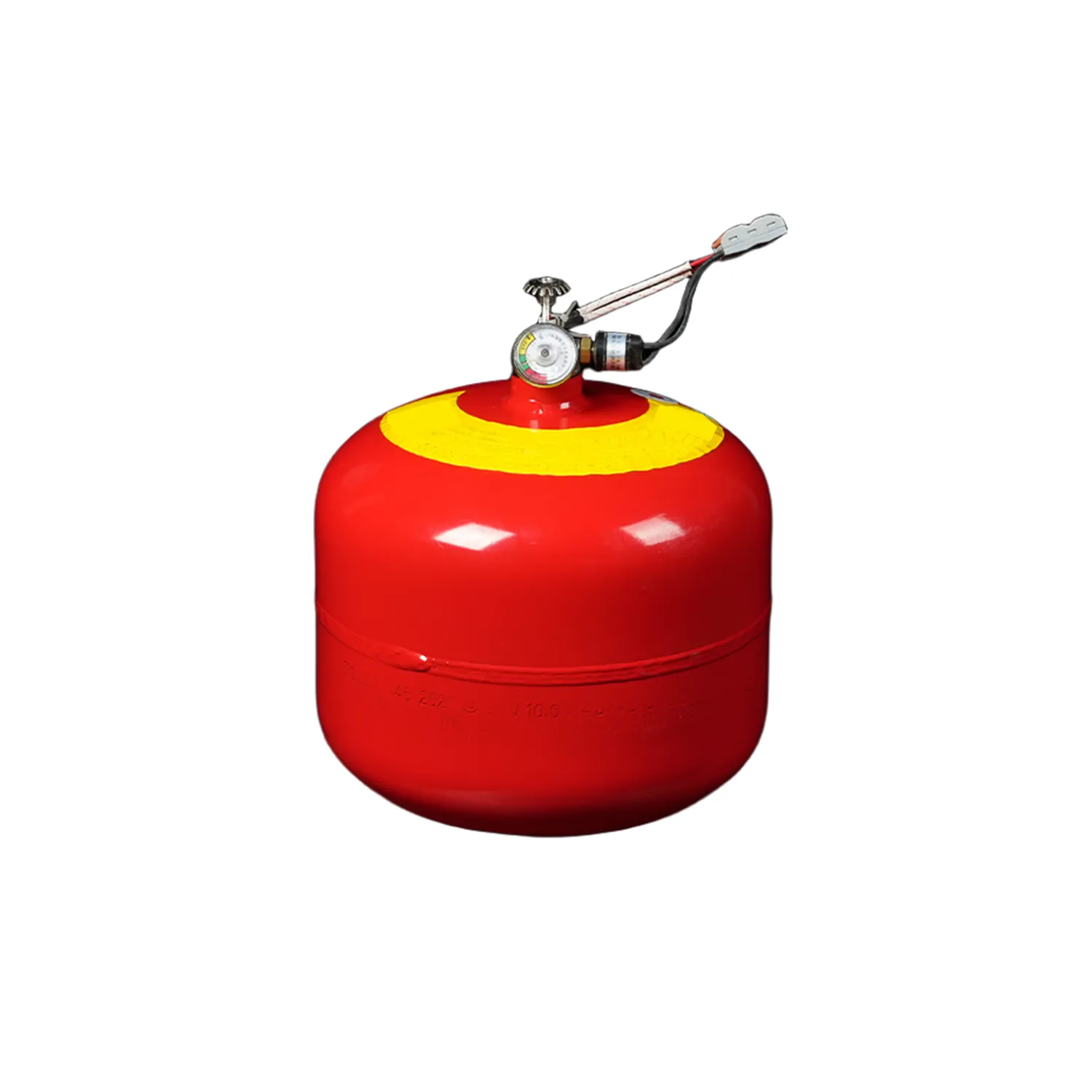
Suspended Configuration
Configuration: A suspended storage arrangement where the selected unit, support structure, discharge pattern, and service access permit overhead installation.
Listed Cylinder Volume: 180 L (47.6 US gal).
Selection Inputs: Provide enclosure dimensions, available mounting height, structural support, obstructions, nozzle layout, and access for inspection and servicing. Mounting above a hazard does not by itself establish coverage or suitability for an open exhaust area.
- Agent and Hazard Match: HFC-227ea systems can be designed for the fire classes and hazards supported by the exact agent and system approval.
- Engineered Discharge: The required agent quantity must be discharged within the time specified by the applicable design requirements. Discharge duration is not a guarantee that every fire will be extinguished within that time.
- Electrically Non-Conductive Agent: HFC-227ea is electrically non-conductive. Equipment suitability still depends on the protected hazard and complete system design.
- Total Flooding Design: Enclosure integrity, design concentration, retention, detection and release controls, and personnel exposure must be addressed for the intended space.
- No Extinguishing-Agent Residue: HFC-227ea does not leave extinguishing-agent residue after discharge.
- Data and Telecommunications Rooms: Enclosed equipment rooms where an engineered clean-agent system is suitable and avoiding extinguishing-agent residue is a project requirement.
- Archives and Technical Rooms: Defined enclosures with the hazard, concentration, leakage, and retention requirements addressed in the system design.
- Industrial Enclosures: Selected equipment or process spaces where the agent rating and complete system are suitable for the identified hazard.
- Multi-Zone Projects: Defined protected zones with the cylinder, pipe, nozzle, detection, and release arrangements designed for the required operating sequence.
| Model | Dimensions (Metric/Imperial) |
| PSNP4.2/90N-XF | φ350 mm × 1,120 mm (13.8 in × 44.1 in) |
| PSNP4.2/120N-XF | φ350 mm × 1,430 mm (13.8 in × 56.3 in) |
| PSNP4.2/150N-XF | φ400 mm × 1,380 mm (15.7 in × 54.3 in) |
| PSNP4.2/180N-XF | φ400 mm × 1,623 mm (15.7 in × 63.9 in) |
| Parameter | Specification |
| Operating Pressure | 4.2 MPa (609 psi) |
| Cylinder Volume | 90L, 120L, 150L, 180L (23.8, 31.7, 39.6, 47.6 gal) |
| Temperature Range | 0°C to 50°C (32°F to 122°F) |
| Power Supply | AC 220V 50Hz (Main); DC 24V (Backup) |
| Activation Methods | Pneumatic, Mechanical Backup |
| Discharge Gas | Nitrogen (≥1.2 MPa / 174 psi) |
Compare FM-200 with other fire suppression system types.