

Since the Industrial Revolution of the 1830s, bootmaking has progressed from handcraft to precision machinery. Across nearly two centuries, five widely used construction methods have shaped how durable boots are built—cemented (adhesive), Blake/Blake-Rapid, Goodyear welt, stitchdown (including Norwegian/Storm variants), and direct injection/attach. Among these, Goodyear welt construction is prized in professional safety footwear for its strength, stitch-anchored bonding, and rebuildable design—qualities that matter in selected firefighter boot designs where heat exposure, load, and service life are non-negotiable.
What Is Goodyear Welt Construction?
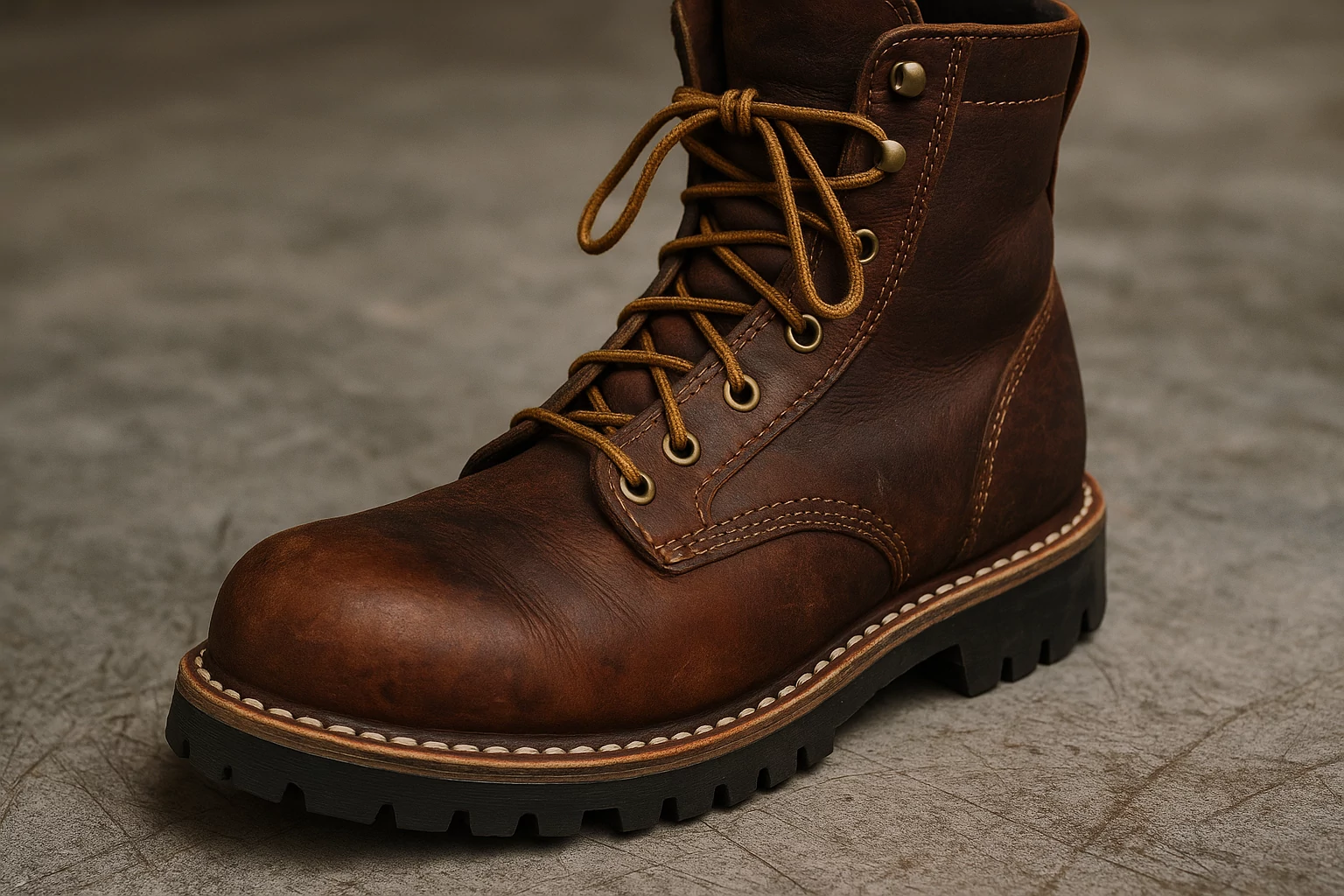
Goodyear welt construction is a durable footwear build where a welt is stitched to the upper and insole, and the outsole is stitched to the welt, creating a strong mechanical joint rather than relying mainly on glue. The practical value is service-life: the outsole can be removed and replaced (resoled) without tearing apart the upper or footbed assembly, which helps extend duty use in high-wear environments.
Goodyear welt construction shows up frequently in premium work boots and fire-service-oriented footwear because it supports predictable performance and repairability when boots see heavy abrasion, repeated flexing, and harsh environments. For departments and industrial buyers, the practical decision point is simple: replace a sole instead of replacing the whole boot—when the boot’s upper and internal structure are still sound.
Firefighting footwear requirements depend on the specific use case and the applicable standard (for example, structural firefighting vs. wildland). Goodyear welt construction is a build method, not a standard by itself—evaluate the full boot (materials, protective features, and certification/labeling) against the standard and hazard profile you’re buying for.
How Goodyear Welt Construction Works
Step 1: Stitch the welt to the upper and insole
A strip of leather or synthetic material (the welt) is stitched to the boot’s upper and to a ribbed insole, typically created with a canvas “gemming” to form that rib. This establishes a stable perimeter that the outsole can later attach to.
Step 2: Fill the cavity for support and comfort
The void between the insole and outsole is commonly packed with cork or similar filler. It compresses and conforms over time, adding cushioning, insulation, and more consistent underfoot support.
Step 3: Stitch the outsole to the welt
The outsole is stitched to the welt in a separate operation (often a durable lockstitch). When the tread wears down, a cobbler or repair shop can remove and replace the outsole while leaving the upper and insole structure intact.
Advantages and Limitations of Goodyear Construction Boots
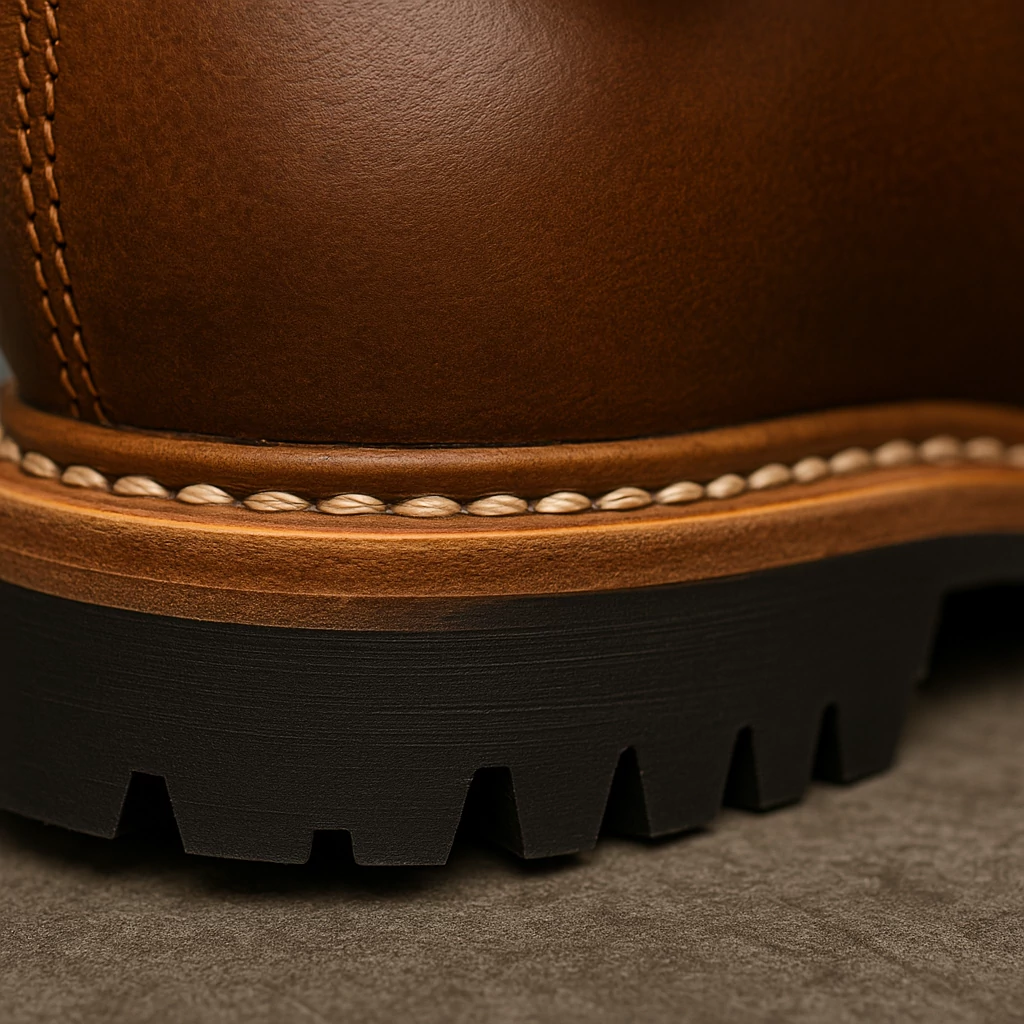
Goodyear welt construction boots are valued for durability, rebuildability, and long-term stability, but they involve trade-offs in weight, flexibility, and upfront cost. For fire service and safety footwear, these pros and cons directly affect procurement decisions, mission suitability, and lifecycle cost.
Advantages
Exceptional durability: The outsole is mechanically stitched to the welt, and the welt is stitched to the upper and ribbed insole. This double-stitch structure resists delamination under heat, torsion, abrasion, and repeated flexing—conditions common in fireground and industrial use.
Resoling and extended service life: Because the outsole is independent of the upper and footbed, Goodyear welt boots can be resoled multiple times—typically one to three cycles, and sometimes more if the welt and upper remain intact. This allows departments to extend boot life instead of replacing the entire pair.
Stable underfoot support for long shifts: The cavity between the insole and outsole is filled with cork or cork/latex compounds. Over time, this material compresses to the wearer’s footprint, improving comfort, shock absorption, and thermal insulation during long duty cycles.
Water resistance with proper design: When combined with tight stitching, proper sealing, and options such as a storm welt, Goodyear welt construction provides strong resistance to surface water and hose spray. While not inherently waterproof, it performs well in wet but non-immersive environments.
Lower total cost of ownership (TCO): Although initial purchase cost is higher, the ability to resole and maintain structural integrity often reduces replacement frequency, making welted boots cost-effective over long service periods.
Limitations
Higher upfront cost: The process requires skilled labor, additional materials (welt, cork filler, double stitching), and longer manufacturing time. As a result, Goodyear welt boots are typically more expensive than cemented or direct-injection footwear.
Increased weight and reduced flexibility: The layered construction adds weight and stiffness compared with cemented or direct-injection builds. This can be a disadvantage for wildland firefighters or users who cover long distances on foot and prioritize lightweight, highly flexible boots.
Longer break-in period: New Goodyear welt boots often feel stiffer initially. Full comfort and natural flex may require several shifts of wear before the materials soften and conform to the foot.
Liquid sealing limits compared with direct injection: While welted boots offer solid water resistance when properly sealed, direct-injection construction generally provides superior liquid barriers in scenarios involving constant immersion, heavy contamination, or aggressive decontamination cycles.
Resole cost considerations: Although resoling extends service life, the cost of a professional resole can be significant. In low-budget programs, this cost may approach that of a lower-quality replacement boot.
When Goodyear Welt Makes Sense
For the U.S. fire service, these advantages and limitations align closely with mission profiles and standards. Structural firefighting boots built to NFPA 1971 often prioritize direct-injection construction for maximum liquid sealing and ease of decontamination. In contrast, NFPA 1977 wildland firefighting boots frequently favor Goodyear welt construction for rebuildability, stability, and comfort during long hikes over rugged terrain.
Procurement specifications commonly reflect these priorities, calling out factors such as welt type, stitch density, storm-welt sealing, thread composition, outsole hardness and lug depth, slip resistance to ASTM F2913, and protective toe performance under ASTM F2413, along with weight targets and shank design.
Goodyear welt construction remains a preferred choice where durability, resoling potential, and long-term stability outweigh the need for minimal weight or absolute liquid sealing.
How Many Times Can Goodyear Welted Soles Be Replaced?
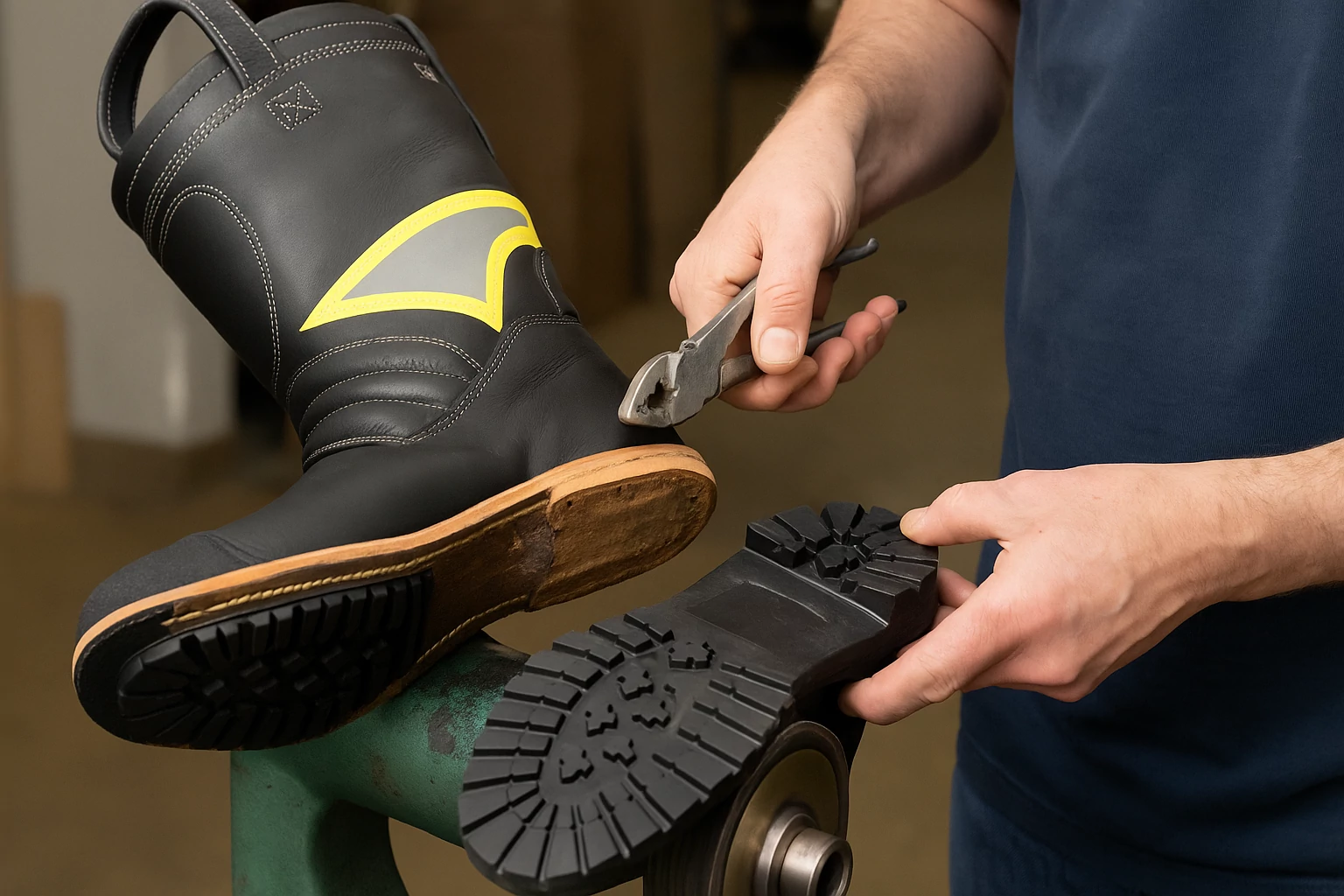
A core benefit of Goodyear welted construction is that the outsole can be removed and replaced while the welt, ribbed insole, and upper leathers remain intact. In real-world service, a Goodyear-welted pair of shoes or boots typically supports one to three resoles, with up to four possible in exceptional cases when the welt is sound, the welt stitching holds, and the quality leathers of the upper show no cracking at the feather line. Each resole involves separating the worn outsole, preparing the welt channel and lockstitch, and attaching a new outsole through the same stitched path; the footbed and the cavity—often filled with cork or a cork/latex mix—stay undisturbed, preserving fit and underfoot stability.
For the fire service, actual resole counts depend on mission profile and exposure. Wildland boots that accumulate miles of abrasion on rock and mineral soil often see the outsole wear out faster than the upper, making two resoles realistic over the product’s life when the welt remains healthy. Structural boots face different stressors—radiant heat, hydrocarbons, and decon chemicals—that can harden or degrade the welt and upper; as a result, departments rarely exceed one professional resole, and many choose to replace rather than rebuild once chemical or heat damage advances beyond the outsole.
Compliance and process control determine whether resoling preserves certification and field safety. Under NFPA 1851 care and maintenance guidelines, repairs that could affect protective performance should be performed by the original manufacturer or an authorized/verified service provider using approved materials and methods. That means matching or specifying an approved outsole compound (e.g., heat-resistant nitrile), maintaining stitch density (SPI) and thread class (often aramid or high-tenacity polyester), resealing a storm welt where present to retain water resistant performance, and documenting the work. If inspection finds a crushed or cracked welt, board delamination, barrier damage, or significant deterioration of the upper leathers, further resoles are no longer reliable—the boot should be retired.
From a lifecycle standpoint, most agencies planning for Goodyear welted footwear assume one scheduled resole during service, with a second possible for wildland duty if the welt and upper remain in serviceable condition. The combination of rebuildability, stable underfoot platform, and preserved fit helps reduce total cost of ownership; however, those gains only hold when resoles are done by qualified providers and when exposure conditions haven’t compromised the welted interface or the high quality shoes and boots themselves.
Why Some Firefighter Boots Use (or Don’t Use) Goodyear Welt
Not every firefighter boot is built with Goodyear welted construction, and the reasons are closely tied to operational standards, field conditions, and lifecycle priorities. For wildland boots certified to NFPA 1977, departments often value the stability, rebuildability, and long-distance comfort that Goodyear welt delivers. The stitched platform, midsole often filled with cork, and firm underfoot support help reduce fatigue during extended hikes on rugged terrain. Because the upper leathers are often made from quality leathers that withstand years of abrasion and heat, the ability to replace worn outsoles once or twice extends the service life of these high quality shoes and boots, lowering total procurement costs over time.
Structural boots designed to NFPA 1971, however, must withstand direct flame, radiant heat, standing water, and aggressive decontamination chemicals. Here, direct-injection soles provide a seamless bond between outsole and upper, eliminating stitch channels that could otherwise allow liquid ingress, and offering superior water resistant and chemical performance. Direct-injection also yields lighter, more flexible boots with faster break-in and easier cleaning. For this reason, most NFPA 1971 bunker boots on the U.S. market are built with direct-injection or cemented soles, while Goodyear welted footwear is reserved for wildland, technical rescue, or station boots where resoling and rebuildability are more valuable than maximum liquid sealing.
From a procurement standpoint, construction choice is often specified directly in RFQs. Departments that select Goodyear welted shoes and boots for NFPA 1977 or station use emphasize lifecycle cost and durability, while agencies purchasing bunker boots generally prioritize chemical resistance, waterproof performance, and compliance. Ultimately, construction methods follow operational risks and NFPA standards rather than tradition, allowing each department to match boot performance with its most critical field needs.
| Feature / Factor | Goodyear Welted Footwear | Direct Injection (DI) Footwear |
|---|---|---|
| Construction Method | Outsole stitched to a strip of leather (welt) attached to upper leathers and ribbed insole; cavity often filled with cork | Outsole injected and chemically bonded directly to the upper, forming a seamless liquid barrier |
| Durability & Lifespan | Very long-lasting; boots can be resoled 1–3 times (sometimes up to 4); lowers lifecycle cost | Outsole usually non-replaceable; once delaminated or worn, the pair of shoes or boots must be retired |
| Comfort & Support | Cork midsole molds to foot over time, creating stable underfoot support for long shifts; better long-distance comfort | More flexible and lightweight out of the box; shorter break-in; often preferred for agility |
| Water & Chemical Resistance | Good water resistant performance with storm welt and sealing, but stitch channels can still allow ingress under immersion or chemicals | Excellent liquid and chemical sealing due to seamless outsole bond; superior for decontamination and immersion |
| Weight & Flexibility | Heavier and stiffer underfoot; break-in required | Lighter, more flexible, quicker to wear in |
| Maintenance | Requires skilled cobbler or authorized service center; resoling must follow NFPA 1851 guidelines | Minimal maintenance; not designed for resoling |
| Typical NFPA Applications | NFPA 1977 Wildland Boots (hiking, abrasion, rebuildability); Station Boots (comfort, serviceability) | NFPA 1971 Structural Boots (interior fire attack, chemicals, decon); also rescue boots requiring max waterproofing |
| Procurement Considerations | Higher upfront investment, but lower total cost of ownership through rebuildability; suited for high quality shoes and boots made with quality leathers | Lower initial price and simpler maintenance, but shorter lifecycle; must budget for full replacement cycles |
| Best Fit | Departments prioritizing durability, resoling, and stability over years of service | Departments prioritizing waterproofing, chemical resistance, light weight, and easy decon |
Goodyear welted construction remains one of the most respected bootmaking methods, offering durability, stability, and rebuildability where long-term performance is essential. In the firefighter footwear field, its value depends on mission needs—often preferred for wildland boots, but balanced against direct-injection designs for structural operations.
In Poseidon, a professional manufacturer of firefighting safety products. We provide a full range of firefighter boots and foot protection solutions—including models built with Goodyear welt construction. Connect with our experts today to enhance your department’s safety performance and strengthen your procurement system.